
Abstracts of the 22nd Meeting of the Interuniversity Institute of Myology
Vol. 36 No. s1 (2026): Abstract book of the Padua Days on Muscle and Mobility Medicine 2026
https://doi.org/10.4081/ejtm.2026.15081

Abstract 082 | Medical outcome quality in rehabilitation: linking muscle quality, performance and patient reported health

Špela Matko 1|2, Ferdinand Prüfer 1|3, Helmut Kern 4|5, Stefan Löfler 1|4, Nejc Šarabon 1|6, Vincent Grote 1|3 | 1Ludwig Boltzmann Institute for Rehabilitation Research, Vienna, Austria; 2Institute for Outcomes Research, Medical University of Vienna, Vienna, Austria; 3Medical University of Graz, Graz, Austria; 4Ludwig Boltzmann Institute for Rehabilitation Research, St Pölten, Austria; 5Physiko & Rheumatherapie, Institute for Physical Medicine and Rehabilitation, St Pölten, Austria; 6Department of Kinesiology, Faculty of Health Sciences, University of Primorska, Izola, Slovenia.

Publisher's note
All claims expressed in this article are solely those of the authors and do not necessarily represent those of their affiliated organizations, or those of the publisher, the editors and the reviewers. Any product that may be evaluated in this article or claim that may be made by its manufacturer is not guaranteed or endorsed by the publisher.
Received: 2 March 2026
Published: 2 March 2026
120
Views
56
Downloads

Authors

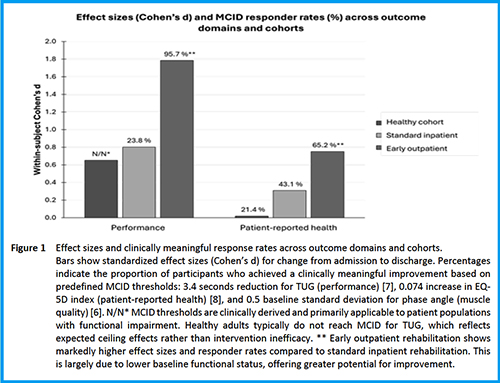
Rehabilitation success is widely recognized as multidimensional, encompassing functional performance, patient-reported health, and physiological integrity [1]. However, routine outcome evaluation often relies on a narrow set of measures, such as pain scores (PROM) or single mobility tests (CROM). These measures are applied heterogeneously across clinics and programs, which limits the comparability and consistency of evaluations. This does not align with what patients and healthcare professionals consider important: in a previous study, we found that both groups value integrated perspectives rather than single endpoints [2]. To reduce interpretative ambivalence and enhance clinical applicability, it is essential to develop multidomain assessment models that integrate objective measures of functional performance, patient-reported health outcomes, and musculoskeletal parameters. Such models could provide a more comprehensive representation of rehabilitation and exercise interventions, potentially capturing dimensions of complexity that single-domain indicators may overlook. We aimed to operationalize a multidomain model of medical outcome quality in rehabilitation, integrating performance and patient reported health. Specifically, we examined whether three distinct exercise therapy settings – a healthy ageing programme and two rehabilitation pathways following knee or hip arthroplasty (early outpatient and standard inpatient) – show similar or divergent response patterns across these domains. Secondary analyses were conducted on three cohorts of older adults: (1) Healthy cohort (N = 131) [3]; (3) Standard inpatient rehabilitation post-arthroplasty (N=160) [4]; (3) Early outpatient rehabilitation post-arthroplasty (N=23) [5]. To operationalize the multidomain model, we defined two primary domains of outcome quality: functional performance and patient-reported health, each represented by one validated factor. Functional performance was assessed using the Timed Up and Go test (TUG), and patient-reported health was assessed using the EQ-5D index. Muscle quality, measured by phase angle (PhA), was included as an exploratory factor in the healthy cohort only. Change from admission to discharge was described with within subject Cohen d, responder rates were based on published minimal clinically important difference (MCID) values [6] and Pearson correlations between change scores. Baseline age and BMI were similar across cohorts (Healthy: 67.6 ± 5.2 years, BMI 28.0; Early outpatient rehabilitation: 66.4 ± 7.6 years, BMI 29.2; Standard inpatient rehabilitation: 67.6 ± 7.8 years, BMI 27.8), with no statistically significant differences between cohorts (age: p = .727; BMI: p = .478). Observed changes are presented below and visualized in Figure 1. Healthy: Patient-reported health (EQ-5D Index): baseline .938 ± .061; mean change .001 ± .070; d = .02; p = .842; 21% responders. Performance (TUG): baseline 6.1 ± 0.9 s; mean change 0.4 ± 0.59 s; d = .65, p < .001). No participant achieved the clinical MCID for TUG. Muscle quality was available only in the healthy cohort and showed a negligible effect (baseline: 5.60 ± .63°; MD: .04 ± .43°; d = .08; p = .358, 15% responders. Standard inpatient rehabilitation: Patient-reported health (EQ-5D Index): baseline .825 ± .140; mean change .047 ± .153; d = .31; p < .001; 43% responders. Performance (TUG): baseline 11.4 ± 4.7 s; mean change 2.6 ± 3.2 s; d = 0.80; p < .001; 24% responders. Early outpatient rehabilitation: Patient-reported health (EQ-5D Index): baseline .721 ± .171; mean change .101 ± .134; d = .75; p < .001; 65% responders). Performance (TUG): baseline 17.8 ± 5.6 s; mean change 7.8 ± 4.4 s; d = 1.79; p < .001; 96% responders. Correlations between domain-specific changes were small to moderate across cohorts (e.g., ΔTUG vs ΔEQ-5D Index: r = .12 (p = .129) in standard inpatient rehabilitation; r = .40 (p = .059) in early inpatient rehabilitation; r = .17 (p = .059) in healthy. Viewing rehabilitation outcomes as multidomain patterns rather than single endpoints enables more nuanced evaluation across programmes. Our analysis showed that functional performance (CROM) achieved the largest gains during the intervention period, whereas muscle quality and patient-reported health (PROM) remained largely stable. Correlations between domain-specific changes were weak to moderate, confirming that these domains capture complementary, non-redundant aspects of outcome quality. This observation aligns with previous findings, which emphasized that PROMs and CROMs provide different but complementary information [4]. Recognizing this multidomain perspective is essential for personalized care, as domains respond differently across rehabilitation settings and time points. For example, MCID thresholds were developed for clinical populations, meaning healthy cohorts rarely achieve them due to ceiling effects, while patients in early outpatient rehabilitation start from lower functional levels and show greater potential for improvement. These baseline-driven differences highlight the need for contextual interpretation rather than uniform thresholds. To address these challenges, future work will focus on developing a multidomain outcome model that integrates functional performance, patient-reported health and muscle quality. This will support personalised interventions, enable comparisons across rehabilitation settings and allow the early recognition of non-responders.

Abs082.jpg

Downloads

Download data is not yet available.

1. Stucki, G., Cieza, A., & Melvin, J. (2007). The International Classification of Functioning, Disability and Health: A unifying model for the conceptual description of rehabilitation strategy. Journal of Rehabilitation Medicine, 39(4), 279–285 https://doi.org/10.2340/16501977-0041.

2. Matko, Š., Vetrano, C., Cristea, D., Riedl, P., Prüfer, F., Fischer, M. J., Steinecker-Frohnwieser, B., Stamm, T., & Grote, V. (2025). What matters in rehabilitation: A mixed methods study of critical success factors from the perspectives of patients and healthcare professionals. European Journal of Translational Myology, 35(3), 14060. https://doi.org/10.4081/ejtm.2025.14060.

3. Pavlović, M., Matko, Š., Prüfer, F., Löfler, S., Fischer, M. J., Grote, V., & Šarabon, N. (2025). Health-related quality of life, body mass index and the 10-metre walk test in patients awaiting total knee or hip arthroplasty: A cross-sectional data analysis with matched controls. Life, 15, 231. https://doi.org/10.3390/life15020231.

4. Bily, W., Jauker, J., Nics, H., Grote, V., Pirchl, M., & Fischer, M. J. (2022). Associations between patient-reported and clinician-reported outcome measures in patients after traumatic injuries of the lower limb. International Journal of Environmental Research and Public Health, 19, 3140. https://doi.org/10.3390/ijerph19053140.

5. Matko, Š., Prüfer, F., Pavlović, M., Löfler, S., Unger, A., Fischer, M. J., Kern, H., Bily, W., Šarabon, N., & Grote, V. (2025). Comparison of outcomes and recovery trajectories: Earlier outpatient versus later inpatient rehabilitation after knee or hip arthroplasty. BMC Musculoskeletal Disorders. under revision.

6. Norman, G. R., Sloan, J. A., & Wyrwich, K. W. (2003). Interpretation of changes in health-related quality of life: The remarkable universality of half a standard deviation. Medical Care, 41(5), 582–592. https://doi.org/10.1097/00005650-200305000-00004.

7. Gautschi, O. P., Stienen, M. N., Corniola, M. V., Joswig, H., Schaller, K., Hildebrandt, G., & Smoll, N. R. (2017). Assessment of the minimum clinically important difference in the Timed Up and Go test after surgery for lumbar degenerative disc disease. Neurosurgery, 80(3), 380–385. https://doi.org/10.1227/NEU.0000000000001320.

8. Walters, S. J., & Brazier, J. E. (2005). Comparison of the minimally important difference for two health state utility measures: EQ-5D and SF-6D. Quality of Life Research, 14(6), 1523–1532. https://doi.org/10.1007/s11136-004-7713-0.

How to Cite


1.
Matko Špela. Abstract 082 | Medical outcome quality in rehabilitation: linking muscle quality, performance and patient reported health: Špela Matko 1|2, Ferdinand Prüfer 1|3, Helmut Kern 4|5, Stefan Löfler 1|4, Nejc Šarabon 1|6, Vincent Grote 1|3 | 1Ludwig Boltzmann Institute for Rehabilitation Research, Vienna, Austria; 2Institute for Outcomes Research, Medical University of Vienna, Vienna, Austria; 3Medical University of Graz, Graz, Austria; 4Ludwig Boltzmann Institute for Rehabilitation Research, St Pölten, Austria; 5Physiko & Rheumatherapie, Institute for Physical Medicine and Rehabilitation, St Pölten, Austria; 6Department of Kinesiology, Faculty of Health Sciences, University of Primorska, Izola, Slovenia. Eur J Transl Myol [Internet]. 2026 Mar. 2 [cited 2026 Apr. 18];36(s1). Available from: https://www.pagepressjournals.org/bam/article/view/15081