

 https://doi.org/10.4081/ejtm.2026.15104
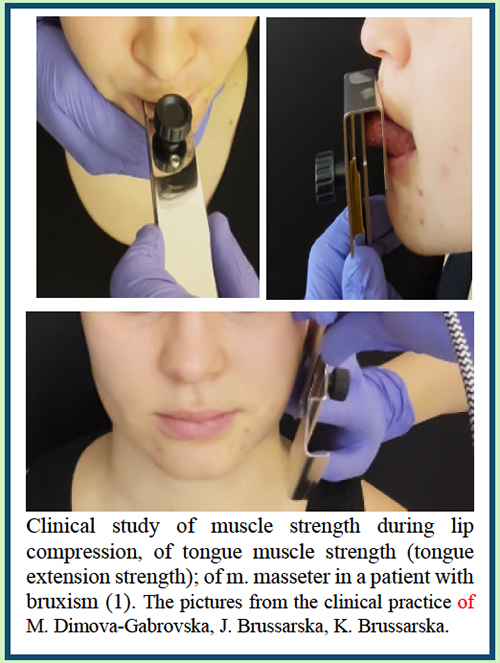
Abstract 105 | Muscle forces in patient with bruxism
Mariana Dimova-Gabrovska | Department of Prosthetic Dentistry, Faculty of Dental medicine of the Medical University -Sofia, Bulgaria.
All claims expressed in this article are solely those of the authors and do not necessarily represent those of their affiliated organizations, or those of the publisher, the editors and the reviewers. Any product that may be evaluated in this article or claim that may be made by its manufacturer is not guaranteed or endorsed by the publisher.
Published: 2 March 2026
Downloads
1. Koc D, Dogan A, Bek B. Bite Force and Influential Factors on Bite Force Measurements: A Literature Review. Eur J Dent. 2010; Apr;4(2):223–32. doi: 10.1055/S-0039-1697833.
2. Dellavia C, Francetti L, Rosati R, Corbella S, Ferrario VF, Sforza C. Electromyographic assessment of jaw muscles in patients with All-on-Four fixed implant-supported prostheses. J Oral Rehabil., 2012; Dec; 39(12): 896-904. doi: 10.1111/joor.12002.
3. Al-Zarea BK. Maximum Bite Force following Unilateral Fixed prosthetic treatment: A Within-Subject Comparison to the Dentate Side. Medical Principles and Practice. 2015;24(2):142-6. doi: 10.1159/000370214.
4. AL‐Omiri M, Sghaireen M, Alhijawi M, Alzoubi I, Lynch C, Lynch E. Maximum bite force following unilateral implant‐supported prosthetic treatment: within‐subject comparison to opposite dentate side. J Oral Rehabil. 2014; Aug;41(8):624–9. doi: 10.1111/joor.12174.
5. Jansen van Vuuren L, Broadbent J, Duncan W, Waddell J. Maximum voluntary bite force, occlusal contact points and associated stresses on posterior teeth. J R Soc N Z. 2020; Jan;50(1):132–43. doi:10.1080/03036758.2019.1691612.
How to Cite

This work is licensed under a Creative Commons Attribution-NonCommercial 4.0 International License.
PAGEPress has chosen to apply the Creative Commons Attribution NonCommercial 4.0 International License (CC BY-NC 4.0) to all manuscripts to be published.