
Abstracts of the 22nd Meeting of the Interuniversity Institute of Myology
Vol. 36 No. s1 (2026): Abstract book of the Padua Days on Muscle and Mobility Medicine 2026
https://doi.org/10.4081/ejtm.2026.15086

Abstract 087 | Ion channel dysregulation and neuronal sensitization as drivers of osteoarthritis pain

Lukas Weigl 1, Bibiane Steinecker-Frohnwieser 2 | 1Clinical Department of Special Anaesthesia and Paintherapy; 2Medical University of Vienna, Vienna, Austria.

Publisher's note
All claims expressed in this article are solely those of the authors and do not necessarily represent those of their affiliated organizations, or those of the publisher, the editors and the reviewers. Any product that may be evaluated in this article or claim that may be made by its manufacturer is not guaranteed or endorsed by the publisher.
Received: 2 March 2026
Published: 2 March 2026
120
Views
44
Downloads

Authors

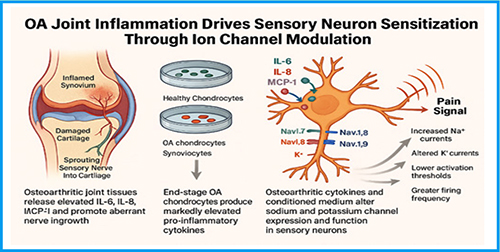
Osteoarthritis (OA) is the most common joint disorder and a major contributor to chronic pain and disability worldwide, with knee OA in particular posing a substantial clinical and socioeconomic burden [1,2]. Although historically viewed as a degenerative cartilage disease, it is now clear that pain—rather than joint structural loss—is the primary driver of functional impairment and healthcare utilization. However, pain correlates only weakly with the severity assessed by radiographic imaging, highlighting the multifactorial and incompletely understood nature of OA pain [3]. Early OA is characterized by subtle changes such as low-grade synovitis, meniscal pathology, and early subchondral bone remodeling, while late-stage OA involves extensive cartilage loss, osteophyte formation, persistent inflammation, and bone marrow lesions. Increasing evidence shows that OA pain encompasses nociceptive, inflammatory, neuropathic-like, and centrally sensitized components, with neuropathic features including burning sensations, allodynia, and hyperalgesia arising from aberrant nerve growth, nerve injury, and altered pain processing within peripheral and central pathways [4]. Peripheral sensory neurons responsible for transmitting joint pain reside in the dorsal root ganglia (DRG) and innervate all joint tissues except cartilage, which is normally aneural and therefore insensitive to noxious stimuli [5]. In OA, however, sensory neurites can aberrantly sprout into cartilage, potentially producing pain, although the mechanisms driving such pathological innervation remain unclear. Sensory neuron excitability is strongly influenced by the expression and function of voltage-gated sodium channels; in pain-sensitive TRPV1-positive neurons, Nav1.7, Nav1.8, and Nav1.9 represent the predominant isoforms, each contributing distinct kinetic properties essential for nociceptive signaling [6]. Notably, OA chondrocytes produce high levels of inflammatory mediators which may alter neuronal excitability by modulating ion channel activity. This suggests that joint-derived cytokines might promote peripheral sensitization and neuropathic-like symptoms by affecting ion channel expression and neuronal firing thresholds. To explore this hypothesis, chondrocytes from end-stage OA and healthy donors were analyzed for cytokine secretion, revealing markedly elevated IL-6, IL-8, and MCP-1 in OA cultures. DRG neurons isolated from 3–6-month-old rats were cultured on poly-D-lysine and treated for 24–48 hours with 10 ng/mL of each cytokine. Whole-cell patch-clamp recordings were performed using reduced extracellular sodium (70 mM) and intracellular Cs-gluconate to isolate sodium currents and assess changes in neuronal excitability. In parallel, conditioned medium from OA chondrocytes and synoviocytes was applied to MHH neuroblastoma cells to determine whether OA-derived factors alter electrophysiological properties or ion channel expression. DRG neurons exposed to OA-associated cytokines exhibited marked changes in electrophysiological behavior, including alterations in Na⁺ currents consistent with a shift in sodium channel subtypes. Conditioned media from OA chondrocytes produced similar effects in neuroblastoma cells, affecting both Na⁺ and K⁺ currents and indicating a rearrangement of ion channel composition. These electrophysiological modifications were accompanied by changes in channel expression, suggesting transcriptional regulation driven by cytokine - receptor interactions. Together, these findings support a model in which elevated inflammatory mediators in the OA joint microenvironment influence sensory neuron ion channel dynamics, enhance neuronal excitability, and contribute to peripheral sensitization and neuropathic-like pain features. In summary, the inflammatory milieu created by OA chondrocytes and synoviocytes may directly modulates sensory neuron function through alterations in voltage-gated ion channels, providing a mechanistic link between joint pathology, aberrant neuronal sensitization, and complex OA pain. These insights underscore the need for continued mechanistic research, supported by emerging tools such as single-cell transcriptomics, tissue - neuron co-culture systems, biomimetic loading models, and targeted manipulation of ion channels. A deeper understanding of these pathways may facilitate the development of mechanism-based analgesics and novel disease-modifying therapies for OA that address both structural pathology and the multifaceted nature of pain. The graphical abstract summarizes how structural joint changes in early and late knee osteoarthritis contribute to pain through inflammatory, mechanical, and neuropathic mechanisms. It highlights neuronal sensitization driven by altered ion channels (e.g., TRPV1, TRPA1, Piezo2, Nav1.7/1.8), aberrant nerve growth, and inflammatory mediators such as NGF and cytokines. Together, these processes converge to produce chronic, disproportionate pain and identify key molecular targets for mechanistic study.

Abs087.jpg

Downloads

Download data is not yet available.

1. Hunter DJ, Bierma-Zeinstra S. Osteoarthritis. Lancet. 2019 Apr 27;393(10182):1745-1759. Doi: 10.1016/S0140-6736(19)30417-9. DOI: https://doi.org/10.1016/S0140-6736(19)30417-9

2. Katz JN, Arant KR, Loeser RF. Diagnosis and treatment of hip and knee osteoarthritis: A review. JAMA. 2021; 325:568-578. doi: 10.1001/jama.2020.22171. DOI: https://doi.org/10.1001/jama.2020.22171

3. Miller RE, Malfait AM. What is new in pain modification in osteoarthritis? Rheumatology. 2018; 57(suppl_4): iv99-iv107. doi: 10.1093/rheumatology/kex522. DOI: https://doi.org/10.1093/rheumatology/kex522

4. Trouvin AP, Perrot S. Pain in osteoarthritis. Implications for optimal management. Joint Bone Spine. 2018 Jul; 85(4):429-434. doi: 10.1016/j.jbspin.2017.08.002. DOI: https://doi.org/10.1016/j.jbspin.2017.08.002

5. Suri S, Walsh DA. Osteochondral alterations in osteoarthritis. Bone. 2012; 51:204-211. doi: 10.1016/j.bone.2011.10.010. DOI: https://doi.org/10.1016/j.bone.2011.10.010

6. Fu W, Vasylyev D, et al. Nav1.7 as a chondrocyte regulator and therapeutic target for osteoarthritis. Nature. 2024; 625: 557–565 (2024). doi: 10.1038/s41586-023-06888-7.

How to Cite


1.
Steinecker-Frohnwieser B. Abstract 087 | Ion channel dysregulation and neuronal sensitization as drivers of osteoarthritis pain: Lukas Weigl 1, Bibiane Steinecker-Frohnwieser 2 | 1Clinical Department of Special Anaesthesia and Paintherapy; 2Medical University of Vienna, Vienna, Austria. Eur J Transl Myol [Internet]. 2026 Mar. 2 [cited 2026 Apr. 17];36(s1). Available from: https://www.pagepressjournals.org/bam/article/view/15086