
Abstracts of the 22nd Meeting of the Interuniversity Institute of Myology
Vol. 36 No. s1 (2026): Abstract book of the Padua Days on Muscle and Mobility Medicine 2026
https://doi.org/10.4081/ejtm.2026.15083

Abstract 084 | Explorative evidence on the sensitivity and specificity of advanced glycation endproducts in reflecting functional recovery during multimodal rehabilitation

Bettina Thauerer, Bibiane Steinecker-Frohnwieser | Ludwig Boltzmann Institute for Arthritis and Rehabilitation, Saalfelden, Gröbming, Vienna, Austria.

Publisher's note
All claims expressed in this article are solely those of the authors and do not necessarily represent those of their affiliated organizations, or those of the publisher, the editors and the reviewers. Any product that may be evaluated in this article or claim that may be made by its manufacturer is not guaranteed or endorsed by the publisher.
Received: 2 March 2026
Published: 2 March 2026
112
Views
39
Downloads

Authors

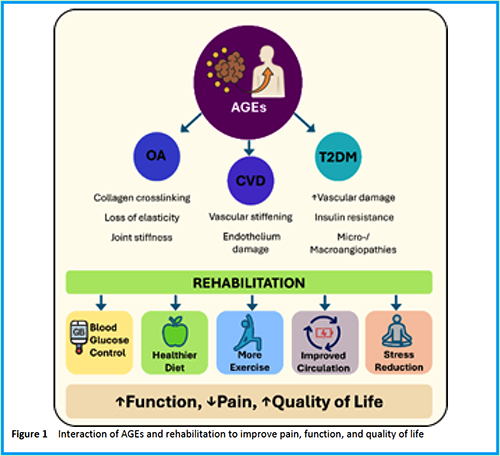
Cardiovascular disorders (CVD), osteoarthritis (OA), and type 2 diabetes mellitus (T2DM) are among the most prevalent chronic diseases worldwide, posing major public health challenges due to their increasing incidence and impact on quality of life. These conditions often coexist and share common pathophysiological mechanisms including chronic inflammation, metabolic dysregulation, oxidative stress and reduced microcirculation. Given the high disease burden and systemic relevance of these conditions, effective disease management therefore requires a multidisciplinary rehabilitation approach integrating medical, nutritional, and physical interventions to improve function and overall health outcomes. Our studies pursue the overarching goal of investigating the influence of inpatient, multidisciplinary rehabilitation programs on a broad spectrum of clinical, laboratory, and psychosocial parameters. In this context, biomarkers are a crucial tool: they enable objective measurement of health status, monitoring of individual progression, and precise evaluation of therapeutic success and, ideally, can also predict it. In this way, a strategy is to be developed to distinguish so-called “rehab responders” from “bad performers” and create the basis for tailor- made therapy programs. The system of Advanced Glycation Endproducts (AGEs) and their soluble receptor (sRAGE) has recently attracted attention as a promising cross-disease biomarker axis. It is a disease-spanning biomarker complex that is closely linked to inflammation and oxidative stress and its dynamics. AGEs are heterogeneous molecules formed through non-enzymatic glycation and oxidation of proteins, lipids, and nucleic acids. They are continuously produced as part of the natural aging process in the body (endogenous AGEs) or are consumed directly through the diet (exogenous AGEs). Their formation is promoted by aging, chronic hyperglycemia (as in diabetes), oxidative stress, and the consumption of highly heated foods (e.g. through grilling or frying). However, the accumulation of these harmful molecules, regardless of their source, has consequences for the body and triggers a chain of reactions. AGEs play a crucial role in the development of atherosclerosis and vascular complications by promoting plaque formation, increasing blood pressure, and inducing vascular stiffening (1). Due to chronic hyperglycemia, AGE formation is greatly increased in diabetics. An accumulation of AGEs correlates with diabetic complications, insulin resistance and poor wound healing (2). Recent research suggests that AGEs may be a molecular cause of the development and progression of osteoarthritis by promoting cartilage degradation, reduction of elasticity and triggering inflammatory reactions in the joint (3). The harmful effects of AGEs are mainly mediated by a special cell-surface receptor, the “Receptor for Advanced Glycation End Products” (RAGE). When an AGE molecule binds to this receptor, a cascade of negative reactions is triggered in the cell. Binding to RAGE stimulates the production of pro-inflammatory messenger substances (cytokines). This contributes to chronic, subclinical inflammatory processes. More harmful oxygen radicals (ROS) are formed in the cell. These attack cell structures and damage them. The oxidative stress triggered by the AGE-RAGE binding in turn accelerates the formation of new AGEs in the body. Studies show that this creates a self-reinforcing cycle: AGEs increase the production of ROS, and the increase in ROS in turn promotes the production of AGEs. Conversely, the soluble form of the receptor (sRAGE) lost the function of transmitting signals and serves as a cytoprotective “decoy receptor,” binding circulating AGEs and preventing their interaction with the membrane-bound RAGE receptor, thus attenuating inflammatory signaling. The ratio of AGEs to sRAGE, referred to as AGE activity (AAct), is used to represent the dynamic equilibrium of this system and provides an integrated measure of oxidative and inflammatory burden and may be more sensitive to physiological change than either parameter alone. A high quotient indicates a predominance of harmful AGEs and insufficient protective function by sRAGE (4). But how can this important balance be influenced once it has been disrupted (5)? This research synthesizes findings from several prospective pre–post studies conducted in Austrian inpatient rehabilitation centers, focusing on patients with OA, CVD, and T2DM. These studies aimed to explore the sensitivity and specificity of AGEs and sRAGE in reflecting functional recovery during multimodal rehabilitation. Patients underwent standardized multimodal rehabilitation programs lasting approximately three to four weeks. Interventions included structured active and passive exercise therapy, dietary changes and nutritional counseling, medical monitoring, and psychosocial support and patients’ education. Blood samples were collected at admission and discharge to measure AGEs and sRAGE via ELISA, and the AGE activity was calculated as a composite marker of oxidative stress. Additional parameters included inflammatory and metabolic markers (CRP, MPO, glucose, lipids, HbA1c, cartilage marker), functional indicators (ergometry, pain, BMI, blood pressure), and psychosocial measures (PHQ-4, EQ-5D). Non-invasive skin autofluorescence (SAF) was also used to estimate long-term AGE accumulation. Positive effects of the multimodal rehabilitation on the AGE system were detectable in the blood and scientifically proven across all diagnostic groups. Exercise therapy improved blood sugar control and had been proven to reduce oxidative stress. Further enhancement of blood circulation and activation of metabolism could support the breakdown process of AGEs. At the same time, the change in diet reduced both the intake of AGEs from external sources and the body's own production through more stable blood sugar levels. In studies, this led to a reduction in serum AGEs after three to four weeks of rehabilitation. The combination of exercise and a healthier lifestyle stimulated the body to produce more protective sRAGE molecules again. This finding indicates a strengthened endogenous defense function against the negative effects of AGEs. The most important evidence of a successful rehabilitation process was a highly significant reduction in the AGE/sRAGE ratio across all clinical pictures examined. These changes were accompanied by significant functional gains, including increase in ergometric capacity, pain reduction and a marked reduction in oxidative stress. Despite the short intervention period, these shifts indicated a systemic reduction of metabolic and inflammatory load. However, the success of these interventions was not the same in all patients and depended heavily on the individual's initial physiological condition. Comorbidities significantly influenced the initial situation and the response to therapy. T2DM patients with metabolic syndrome (MetS) had poorer baseline values (6). In osteoarthritis patients, the primary rehabilitation indication (musculoskeletal vs. cardiovascular) affected the condition of the cartilage and the success of therapy. Explorative analyses revealed that the sensitivity of AGE activity was strongly baseline dependent. The change in AGE activity was correlated inversely with its baseline value (r = –0.564, p < 0.001), showing that patients with the highest initial AGE burden achieved the most pronounced improvement (4). A key problem in the evaluation of rehabilitation measures is that looking at the overall collective alone often fails to reveal any intervention-related changes. This is because the individual improvements of patients with initially poor values and the slight deterioration of patients with initially good values can cancel each other out. Only by taking individual baseline values into account is it possible to validly assess the success of rehabilitation and reveal the true effects of a therapy. We developed an approach (7) to stratify patients based on their initial biomarker values, which made it possible to functionally classify biomarkers into three groups that describe their behavior in response to rehabilitation: Constitutional biomarkers (e.g. sRAGE) reflect stable between-subject differences and show little to no responsiveness to the intervention. Critical Starting Point Biomarkers (CSPBs), including AGE activity, demonstrate significant change over time, particularly in individuals with unfavorable baseline values. Homeodynamic Biomarkers (HBs) display strong responsiveness and normalization tendencies during intervention, especially in participants with initially high or low values. These distinct biomarker response types underscore the relevance of stratified approaches in health monitoring and rehabilitation outcomes. The practical significance of this classification is immense. It enables the identification of specific patient groups such as “rehab responders” versus “bad performers” and thus supports the selection of suitable, personalized therapy approaches. We can conclude that the AGE/sRAGE system has proven to be a key biomarker. A significant reduction in the AGE activity serves as a robust, cross-disease indicator of the success of multidisciplinary rehabilitation measures for OA, CVD, and T2DM (Figure 1). This research provides a roadmap for implementing precision-guided rehabilitation. The consistent use of biomarker analyses in a validated stratification approach enables more precise classification of patients before and after an intervention. This forms the basis for the development of truly personalized therapy programs. Instead of a “one-size-fits-all” approach, interventions can be tailored to the individual biological and physiological profile of the patient. This will not only maximize the efficiency and effectiveness of rehabilitation but also help to use resources in a more targeted manner and achieve the greatest possible health benefits for each individual patient.

Abs084.jpg

Downloads

Download data is not yet available.

1. Hooshiar SH, Esmaili H, Taherian A, & Jafarnejad S. Exercise, Advanced Glycation End Products, and Their Effects on Cardiovascular Disorders: A Narrative Review. Heart and Mind 6(3), 2022. DOI: 10.4103/hm.hm_31_22.

2. Lin H, Yang Y, Wang X, Chung M, Zhang L, Cai S, Pan X, Pan Y. Targeting the AGEs-RAGE axis: pathogenic mechanisms and therapeutic interventions in diabetic wound healing. Front. Med., Sec. Translational Medicine 12, 2025. DOI:10.3389/fmed.2025.1667620.

3. He CP, Chen C, Jiang XC, Li H, Zhu LX, Wang PX, Xiao T. The role of AGEs in pathogenesis of cartilage destruction in osteoarthritis. Bone Joint Res., 11(5), 2022. DOI:10.1302/2046-3758.

4. Odrovicsné-Tóth A, Thauerer B, Stritzinger B, Kullich W, Salzer A, Skoumal M, Steinecker-Frohnwieser B. The Patient’s Physiological Status at the Start Determines the Success of the Inpatient Cardiovascular Rehabilitation Program. J. Clin. Med.12, 2023. DOI:10.3390/jcm12051735.

5. Zhang Y, Zhang Z, Tu C, Chen X, He R. Advanced Glycation End Products in Disease Development and Potential Interventions. Antioxidants 14, 2025. DOI:10.3390/antiox14040492.

6. Thauerer B, Odrovicsné Tóth A, Salzer A, Steinecker-Frohnwieser B. Success of an Inpatient Rehabilitation Program in Subjects with Type 2 Diabetes Mellitus with or Without Metabolic Syndrome. Biomolecules 14, 2024. DOI:10.3390/biom14121527.

7. Thauerer, B, Odrovicsné Tóth A, Salzer A, Steinecker-Frohnwieser B. Osteoarthritis and Cartilage 32, 2024. DOI:10.1016/j.joca.2024.02.195.

How to Cite


1.
Thauerer B. Abstract 084 | Explorative evidence on the sensitivity and specificity of advanced glycation endproducts in reflecting functional recovery during multimodal rehabilitation: Bettina Thauerer, Bibiane Steinecker-Frohnwieser | Ludwig Boltzmann Institute for Arthritis and Rehabilitation, Saalfelden, Gröbming, Vienna, Austria. Eur J Transl Myol [Internet]. 2026 Mar. 2 [cited 2026 Apr. 18];36(s1). Available from: https://www.pagepressjournals.org/bam/article/view/15083