Abstracts of the 22nd Meeting of the Interuniversity Institute of Myology
Vol. 36 No. s1 (2026): Abstract book of the Padua Days on Muscle and Mobility Medicine 2026
https://doi.org/10.4081/ejtm.2026.15054

Abstract 055 | The importance of mitochondrial stress response regulators in aged muscle

Victoria C. Sanfrancesco, David A. Hood | Muscle Health Research Centre, School of Kinesiology and Health science, York University, Toronto, Canada.

Publisher's note
All claims expressed in this article are solely those of the authors and do not necessarily represent those of their affiliated organizations, or those of the publisher, the editors and the reviewers. Any product that may be evaluated in this article or claim that may be made by its manufacturer is not guaranteed or endorsed by the publisher.
Received: 2 March 2026
Published: 2 March 2026
94
Views
36
Downloads

Authors

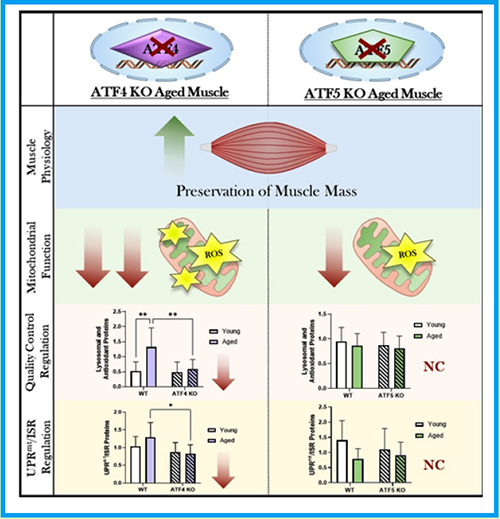
In skeletal muscle, the health and adaptive capacity of the mitochondrial network is regulated by mitochondrial quality control (MQC) mechanisms (1). The Mitochondrial Integrated Stress Response (ISR) and Unfolded Protein Response (UPRmt) are conserved regulatory processes that can become activated in response to a variety of organellar stressors (2). This quality control architype is primarily regulated by the transcription factors, ATF4 and ATF5, which can coordinate a nuclear response to promote the restoration of mitochondrial homeostasis (3). Beyond these canonical functions, both ATF4 and ATF5 can also mediate other mitochondrial quality control processes and thereby influence the adaptive and restorative capacity of the network (4, 5). While a dynamic and efficient mitochondrial reticulum is essential for skeletal muscle function, with age, mitochondrial quality becomes disrupted contributing to aberrations in muscle health (6). Although previous work has demonstrated a role for both ATF4 and ATF5 in propagating mitochondrial health via the mediation of MQC processes in young skeletal muscle (4, 5), this regulation has not been evaluated with age. To therefore investigate the importance of such transcription factors in maintaining mitochondrial and muscle health with age, we utilized aged ATF4 and ATF5 KO mice with associated WT counterparts (results summarized in Figure 1). We first assessed muscle mass and contractile kinetics using an acute contractile activity protocol of mouse hindlimb muscle via sciatic nerve stimulation. Interestingly, the canonical decline in muscle mass typically associated with age was prevented in the absence of both ATF4 and ATF5. To ascertain the molecular mechanisms underlying this preservation, we next assessed the expression of muscle atrophy markers, MuRF-1, GADD45α, p21, and p53, which were similarly blunted in aged ATF4 and ATF5 KO mice. This suggests a regulatory role for both transcription factors in mediating muscle protein degradation with age. Muscle quality, reflected by reduced maximal twitch and tetanic force per muscle weight, was impaired by the loss of ATF4 but not ATF5, indicating a greater reliance on ATF4 for age-related muscle health. To examine the functional capacity and thus health of the mitochondrial reticulum, we next investigated mitochondrial respiration and ROS emission. We observed a stark reduction in active respiration and mitochondrial H2O2 emission in young ATF4 and ATF5 KO mice, however with age, these parameters were only perturbed in the absence of ATF4. These findings indicate that both ATF4 and ATF5 support mitochondrial health in young muscle, however, the presence of ATF4 becomes more critical with age for the maintenance of mitochondrial functioning. In order to ascertain the precise roles of both ATF4 and ATF5 in governing mitochondrial quality with age, we next analyzed the expression of autophagy and lysosomal related proteins. Interestingly, deficits in this quality control program were only evident in ATF4 KO muscle, represented by a blunted expression of various related proteins. Similarly, antioxidant-related proteins, which are also responsive to changes in mitochondrial ROS during stress conditions, were only blunted in ATF4 KO muscle. These findings emphasize the requirement for ATF4 to modulate mitochondrial quality control mechanisms in aging muscle. Lastly, the canonical regulation of the ISR/UPRmt was negatively altered solely in ATF4 KO muscle, demonstrating a hierarchal regulation of the mitochondrial stress response. In sum, these data thereby suggest that ATF4 and ATF5 are required to mediate mitochondrial muscle health with age, however, ATF4 is more critical in this determination, alongside the regulation of other quality control processes. Future work will reveal the precise underlying mechanisms that contribute to the importance of ATF4 signaling in aging muscle.

Abs055.jpg

Downloads

Download data is not yet available.

1. Kotiadis VN, Duchen MR, Osellame LD. Mitochondrial quality control and communications with the nucleus are important in maintaining mitochondrial function and cell health. Biochim Biophys Acta. 2014 Apr;1840(4):1254-65. doi: 10.1016/j.bbagen.2013.10.041. Epub 2013 Nov 6. PMID: 24211250; PMCID: PMC3970188.

2. Anderson NS, Haynes CM. Folding the Mitochondrial UPR into the Integrated Stress Response. Trends Cell Biol. 2020 Jun;30(6):428-439. doi: 10.1016/j.tcb.2020.03.001. Epub 2020 Apr 2. PMID: 32413314; PMCID: PMC7230072.

3. Quirós PM, Prado MA, Zamboni N, D'Amico D, Williams RW, Finley D, Gygi SP, Auwerx J. Multi-omics analysis identifies ATF4 as a key regulator of the mitochondrial stress response in mammals. J Cell Biol. 2017 Jul 3;216(7):2027-2045. doi: 10.1083/jcb.201702058. Epub 2017 May 31. PMID: 28566324; PMCID: PMC5496626.

4. Slavin MB, Kumari R, Hood DA. ATF5 is a regulator of exercise-induced mitochondrial quality control in skeletal muscle. Mol Metab. 2022 Dec;66:101623. doi: 10.1016/j.molmet.2022.101623. Epub 2022 Nov 1. PMID: 36332794; PMCID: PMC9661517.

5. Memme JM, Sanfrancesco VC, Hood DA. Activating transcription factor 4 regulates mitochondrial content, morphology, and function in differentiating skeletal muscle myotubes. Am J Physiol Cell Physiol. 2023 Jul 1;325(1):C224-C242. doi: 10.1152/ajpcell.00080.2023. Epub 2023 Jun 5. PMID: 37273238.

6. Marzetti E, Calvani R, Coelho-Junior HJ, Landi F, Picca A. Defective mitochondrial quality control in the aging of skeletal muscle. Mech Ageing Dev. 2025 Dec;228:112112. doi: 10.1016/j.mad.2025.112112. Epub 2025 Sep 8.

How to Cite


1.
Sanfrancesco VC. Abstract 055 | The importance of mitochondrial stress response regulators in aged muscle: Victoria C. Sanfrancesco, David A. Hood | Muscle Health Research Centre, School of Kinesiology and Health science, York University, Toronto, Canada. Eur J Transl Myol [Internet]. 2026 Mar. 2 [cited 2026 Apr. 17];36(s1). Available from: https://www.pagepressjournals.org/bam/article/view/15054