
Abstracts of the 22nd Meeting of the Interuniversity Institute of Myology
Vol. 36 No. s1 (2026): Abstract book of the Padua Days on Muscle and Mobility Medicine 2026
https://doi.org/10.4081/ejtm.2026.15026

Abstract 027 | Investigating skeletal muscle diseases and therapeutics in a donor-derived bioengineered muscle platform

Karly A. Caples 1, Yangyi Edward Luo 2, Alexa Cooney 1, Elisabeth Barton 2, Karen Hecht 3, Siobhan Malany 1 | 1Department of Cellular and Systems Pharmacology, College of Pharmacy, University of Florida, Gainesville, FL, 32610; 2Department of Applied Physiology and Kinesiology, College of Health and Human Performance, University of Florida, Gainesville, FL, 32611 3AstraReal, Inc Karly A. 7761 Randolph Rd. NE, Moses Lake, WA 98837.

Publisher's note
All claims expressed in this article are solely those of the authors and do not necessarily represent those of their affiliated organizations, or those of the publisher, the editors and the reviewers. Any product that may be evaluated in this article or claim that may be made by its manufacturer is not guaranteed or endorsed by the publisher.
Received: 2 March 2026
Published: 2 March 2026
82
Views
44
Downloads

Authors

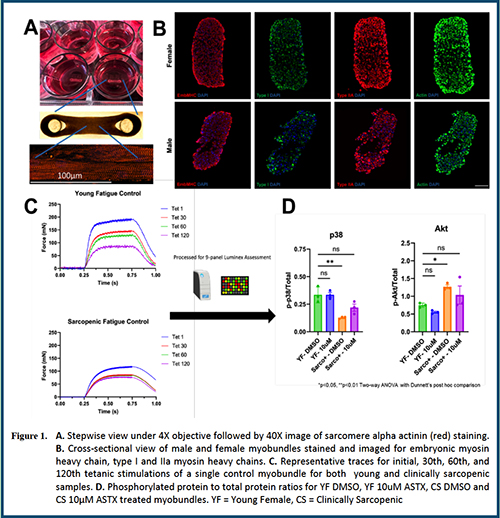
Animal models and human 2D culture models have been instrumental for investigating skeletal muscle diseases and the development of therapeutics. However in vivo models and 2D cultures are limited in their translation to clinical application. These limitations are most evident through the success of myostatin inhibitors for improving mass and function in mice studies followed by unsuccessful clinical trials in patients with sarcopenia and Duchenne Muscular Dystrophy (DMD) (3-4). Although clinical trials of myostatin inhibitors have often reported increases in lean muscle mass, efficacy endpoints of improved muscle function are typically not achieved (3-4). Additionally, studies of age-related muscle atrophy, sarcopenia, have unique barriers to translation such as age-related gene expression changes and sex related muscle aging that is not conserved between species (1-2). Due to these challenges, our team developed a donor-derived 3D skeletal muscle platform housed in standard 24-well imaging plates. This platform was then utilized to investigate retention of sex- specific characteristics in 3D muscle cultures and the effectiveness of astaxanthin (ASTX) to improve contractile signaling and function in healthy and clinically sarcopenic 3D cultures. Initial characterization and validation were carried out in samples from healthy male and female donors. Contractile function recorded through digital image correlation (DIC) analysis during electrical stimulation was similar between male and female 3D muscles, but females displayed elevated type 1 fiber proportions compared to males. Female muscle also displayed elevated levels of OPA1 and TFAM protein levels along with decreased Akt signaling. Overall, female muscle exhibited a greater reliance on mitochondrial energy utilization and reduced protein synthesis indicating retention of sex-specific characteristics in 3D culture. Samples from young female and clinically sarcopenic female donors were studied in this platform for functional differences in force production, fatigue susceptibility, and contractile protein signaling following fatigue with or without astaxanthin antioxidant therapy. Astaxanthin was assessed at 1μM, 10μM, and 25μM in young cultures and only 10μM in sarcopenic cultures due to limitations in cell quantity for 7 days. Although there were no significant effects on force outputs or fatiguability for either group, 10μM rescued P38 and Akt signaling in the sarcopenic samples restoring levels to those exhibited by young DMSO- treated controls. Additionally, 10μM and 25μM in the young cohort suppressed Akt signaling indicating astaxanthin may negatively impact this critical pathway for exercise adaptation in healthy muscle. Although astaxanthin did not improve functional performance in the clinically sarcopenic or young female 3D muscle samples, clenbuterol was evaluated as a positive control for improving performance in young muscle and showed a nearly two-fold increase in both twitch and tetanic force response in 1μM treated samples compared to DMSO controls. These findings support the utilization of this muscle platform for assessing functional differences among drug treatments and untreated donor groups.

Abs027.jpg

Downloads

Download data is not yet available.

1. Börsch, A., Ham, D.J., Mittal, N. et al. Molecular and phenotypic analysis of rodent models reveals conserved and species-specific modulators of human sarcopenia. Commun Biol 4, 194 (2021). https://doi.org/10.1038/s42003-021-01723-z. DOI: https://doi.org/10.1038/s42003-021-01723-z

2. de Jong JCBC, Caspers MPM, Worms N, Keijzer N, Kleemann R, Menke AL, Nieuwenhuizen AG, Keijer J, Verschuren L, van den Hoek AM. Translatability of mouse muscle-aging for humans: the role of sex. Geroscience. 2024 Jun;46(3):3341-3360. doi: 10.1007/s11357-024-01082-7. Epub 2024 Jan 24. PMID: 38265577; PMCID: PMC11009184. DOI: https://doi.org/10.1007/s11357-024-01082-7

3. Lee SJ, Bhasin S, Klickstein L, Krishnan V, Rooks D. Challenges and Future Prospects of Targeting Myostatin/Activin A Signaling to Treat Diseases of Muscle Loss and Metabolic Dysfunction. J Gerontol A Biol Sci Med Sci. 2023 Jun 16;78(Suppl 1):32-37. doi: 10.1093/gerona/glad033. PMID: 36738276; PMCID: PMC10272974. DOI: https://doi.org/10.1093/gerona/glad033

4. Rybalka E, Timpani CA, Debruin DA, Bagaric RM, Campelj DG, Hayes A. The Failed Clinical Story of Myostatin Inhibitors against Duchenne Muscular Dystrophy: Exploring the Biology behind the Battle. Cells. 2020 Dec 10;9(12):2657. doi: 10.3390/cells9122657. PMID: 33322031; PMCID: PMC7764137. DOI: https://doi.org/10.3390/cells9122657

How to Cite


1.
Caples KA. Abstract 027 | Investigating skeletal muscle diseases and therapeutics in a donor-derived bioengineered muscle platform: Karly A. Caples 1, Yangyi Edward Luo 2, Alexa Cooney 1, Elisabeth Barton 2, Karen Hecht 3, Siobhan Malany 1 | 1Department of Cellular and Systems Pharmacology, College of Pharmacy, University of Florida, Gainesville, FL, 32610; 2Department of Applied Physiology and Kinesiology, College of Health and Human Performance, University of Florida, Gainesville, FL, 32611 3AstraReal, Inc Karly A. 7761 Randolph Rd. NE, Moses Lake, WA 98837. Eur J Transl Myol [Internet]. 2026 Mar. 2 [cited 2026 Apr. 17];36(s1). Available from: https://www.pagepressjournals.org/bam/article/view/15026