
Abstracts of the 22nd Meeting of the Interuniversity Institute of Myology
Vol. 36 No. s1 (2026): Abstract book of the Padua Days on Muscle and Mobility Medicine 2026
https://doi.org/10.4081/ejtm.2026.15022

Abstract 023 | Fibro-adipogenic progenitors: gatekeepers for skeletal muscle mass maintenance

Yangyi E. Luo 1, Young il Lee2|3, Zoe Abe-Teh 1, Diana C. Muller 1, Lan Wei-LaPierre 1|3, Elisabeth R. Barton 1|3 | 1Department of Applied Physiology and Kinesiology, College of Health and Human Performance, University of Florida; 2Department of Pharmacology and Therapeutics, College of Medicine, University of Florida; 3Myology Institute, University of Florida, Gainesville, Florida, USA .

Publisher's note
All claims expressed in this article are solely those of the authors and do not necessarily represent those of their affiliated organizations, or those of the publisher, the editors and the reviewers. Any product that may be evaluated in this article or claim that may be made by its manufacturer is not guaranteed or endorsed by the publisher.
Received: 2 March 2026
Published: 2 March 2026
92
Views
33
Downloads

Authors

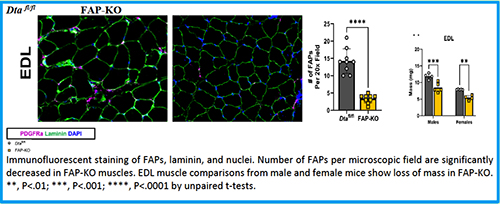
Skeletal muscle maintenance involves coordinated interactions of multinucleated myofibers and distinct mononuclear cell populations, including satellite cells (SCs), resident macrophages, and Fibro-Adipogenic Progenitors (FAPs). FAPs, typically identified by surface expression of PDGFRα (1), are well-characterized for their role in the regenerative response following acute injury (2, 3). However, their contribution to basal muscle homeostasis and contractile mechanics remains poorly understood. To investigate this, we utilized a tamoxifen-inducible FAP-depletion model (PdgfraCre-ERT2/+; Rosa26^DTA/+). Following tamoxifen administration, we observed a rapid and significant reduction in FAP density, which directly correlated with a precipitous loss of muscle mass. To determine if this atrophy impacted functional performance, we conducted ex vivo contractile measurements on the Extensor Digitorum Longus (EDL) and Soleus (SOL) muscles. While FAP-depleted muscles exhibited significant reductions in absolute twitch and maximal tetanic force, specific force (normalized to cross-sectional area) remained unchanged. These results indicate that while FAPs are indispensable for maintaining muscle volume, they are not required for intrinsic force transmission or the contractile apparatus's functionality. We further investigated whether this atrophy was secondary to neurogenic decay. Surprisingly, despite the rapid loss of muscle mass, whole-mount staining of the neuromuscular junction (NMJ) (4) revealed preserved integrity. Structural indices, innervation patterns, and the expression of denervation-responsive transcripts (AchRα/β/γ) were largely unaffected, suggesting that FAPs regulate muscle mass through a mechanism independent of neural input. To identify the molecular drivers of this phenotype, we performed transcriptomic profiling during the acute phase of FAP ablation. We observed a rapid induction of the ubiquitin-proteasome and autophagy-lysosome pathways, evidenced by the upregulation of atrogenes Murf1, Atrogin-1, p62, and Ulk1. This was preceded by a robust inflammatory signature, including elevated levels of the chemokines Ccl2, Cxcl1, and Cxcl2, and significant infiltration of macrophages and neutrophils. To test if these myeloid cells drove the atrophic response, we performed systemic depletion using Clodronate liposomes and anti-Ly6G. Myeloid depletion failed to rescue muscle mass and instead exacerbated the atrophic phenotype and atrogene expression. Notably, Cxcl1 and Cxcl2 remained elevated in the absence of macrophages and neutrophils, suggesting a myofiber-intrinsic or local stromal response to FAP loss. In summary, our findings demonstrate that FAPs are critical regulators of the muscle immune microenvironment. We propose that FAPs exert a protective, immune-suppressive effect that prevents pathological chemokine signaling. Loss of this regulation triggers a Cxcl1/2-mediated atrophic program independent of NMJ disruption. Given that FAP dysfunction is a hallmark of age-related sarcopenia, this FAP-CXCL1/2 axis represents a novel therapeutic target for combating chronic muscle wasting.

Abs023.jpg

Downloads

Download data is not yet available.

1. Uezumi A, Fukada S, Yamamoto N, Takeda S, Tsuchida K. Mesenchymal progenitors distinct from satellite cells contribute to ectopic fat cell formation in skeletal muscle. Nat Cell Biol. 2010; 12(2): 143-52. PMID: 20081842.

2. Joe AW, Yi L, Natarajan A, Le Grand F, So L, Wang J, Rudnicki MA, Rossi FM. Muscle injury activates resident fibro/adipogenic progenitors that facilitate myogenesis. Nat Cell Biol. 2010;12(2): 153-63. PMID: 20081841. 2026 Pd3m Secretariate: Ugo Carraro – A-C M-C Foundation - Email: ugo.carraro@unipd.it - Ugo Carraro mobile: +39 338 1575745 – Barabara Ravara - A-C M-C Foundation - Email:barbara.ravara@unipd.it

3. Wosczyna MN, Konishi CT, Perez Carbajal EE, Wang TT, Walsh RA, Gan Q, Wagner MW, Rando TA. Mesenchymal Stromal Cells Are Required for Regeneration and Homeostatic Maintenance of Skeletal Muscle. Cell Rep. 2019; 27(7):2029-35 e5. PMID: 31091443.

4. Wu H, Mei L. Morphological analysis of neuromuscular junctions by immunofluorescent staining of whole-mount mouse diaphragms. Methods Mol Biol. 2013;1018: 277-85. PMID: 23681637.

How to Cite


1.
Barton E. Abstract 023 | Fibro-adipogenic progenitors: gatekeepers for skeletal muscle mass maintenance: Yangyi E. Luo 1, Young il Lee2|3, Zoe Abe-Teh 1, Diana C. Muller 1, Lan Wei-LaPierre 1|3, Elisabeth R. Barton 1|3 | 1Department of Applied Physiology and Kinesiology, College of Health and Human Performance, University of Florida; 2Department of Pharmacology and Therapeutics, College of Medicine, University of Florida; 3Myology Institute, University of Florida, Gainesville, Florida, USA . Eur J Transl Myol [Internet]. 2026 Mar. 2 [cited 2026 Apr. 17];36(s1). Available from: https://www.pagepressjournals.org/bam/article/view/15022