
Abstracts of the 22nd Meeting of the Interuniversity Institute of Myology
Vol. 36 No. s1 (2026): Abstract book of the Padua Days on Muscle and Mobility Medicine 2026
https://doi.org/10.4081/ejtm.2026.15020

Abstract 021 | Hyper oxygenate blood adding isometric contractions to home full-body in-bed gym until volitional fatigue. A live demonstration

Ugo Carraro 1|2|3, Barbara Ravara 1|2, Maria Chiara Maccarone 2|4 | 1Department of Biomedical Sciences, University of Padua; 2A&C M-C Foundation, Padua; 3School of Physical Medicine and Rehabilitation, Department of Neuroscience, University of Padova, Italy 4Department of Neuroscience, Physical Medicine and Rehabilitation Unit, University Padua, Padua, Italy 4Department of Neuroscience, Physical Medicine and Rehabilitation Unit, University Padua, Padua, Italy.

Publisher's note
All claims expressed in this article are solely those of the authors and do not necessarily represent those of their affiliated organizations, or those of the publisher, the editors and the reviewers. Any product that may be evaluated in this article or claim that may be made by its manufacturer is not guaranteed or endorsed by the publisher.
Received: 2 March 2026
Published: 2 March 2026
84
Views
33
Downloads

Authors

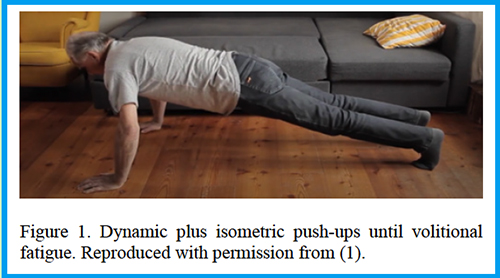
Adherence of patients to training/rehabilitation prescriptions is an important issue that physicians address without often being successful. (1) This is not the case of one of us, who has developed a progressive daily routine of full-body in-bed dynamic exercises since 2017. (2) UC gradually increased in number and intensity the daily training before performing the final morning goal: a series of push-ups on the floor until volitional fatigue. By the summer of 2025, he added isometric exercises maintaining the muscles’ contraction of each repetition for ten breaths (about 30 seconds), the “2025 new standard” for well fitted people. It consists of around 50 different dynamic or isometric exercises performed in different positions, lying down, sitting in and getting out of bed, standing and, finally, doing push-ups on the floor. Still lying in bed, the ten repetitions of the first ten dynamic exercises warm up almost all the body muscles. Then 10 sitting-in-bed dynamic exercises can be progressively added followed by thirty dynamic exercises performed while getting out of bed. For sedentary older adults, the initial warm-up should be performed slowly with just three repetitions per exercise, followed by the dynamic exercises performed sitting in bed and then standing. (1,2) Only the more experienced elders, who have been training for many months or years, should add progressively the isometric exercises: five while lying in bed, five while sitting-in-bed, twenty while getting out of bed, and seventy while standing with the back against a wall. The daily work out should always end with dynamic and or isometric push-ups either in bed or on the floor, performed until volitional fatigue, meaning the point at which the individual can no longer complete another repetition. Incremental isometric routines were introduced after testing blood oxygenation during night's rest and after the Bed-Gym-at-volitional-fatigue, using a pulse oximeter applied to the left medial finger. Surprisingly, at least to our knowledge, from 90-92% oxygenation during the night, the pulse oximeter jumps up to values of almost 100% immediately performing push-ups to volitional fatigue on the floor. (1) Whether this is an artifact of the pulse oximeter or the consequence of the deep, uncontrollable breathing induced by intense exercise is an open question. If this is true hyperoxygenation of the blood, it may be part of the mechanisms that improve not only skeletal and respiratory muscles, (3) but also brain, contributing to the mood-boosting effect of daily morning exercise. (1,2) Whatever the mechanisms, the effect on mood is like that induced by a glass of good Serprino, a Prosecco - like wine of the Euganean Hills (that slightly increases alcohol content in blood and brain), which we are encouraged to enjoy after the discussion of this presentation. In any case, what is certain is that oxygen therapy and hyperbaric oxygen therapy are helpful in many pathologies. (4,5).

Abs021.jpg

Downloads

Download data is not yet available.

1. Carraro Ugo. How to rejuvenate at 80’s. CLEUP sc, University of Padova, Italy. 2024. ISBN 978-88-5495-727-5. 2024: 1-190.

2. Maccarone MC, Caregnato A, Regazzo G, Carriero A, Casellato G, Finamoni C, Jirillo R, Laskova O, Marigo E, Sánchez DY, Seno I, Venturin C, Veronese H, Ravara B, Giurati W, Carraro U, Masiero S. Effects of the Full-Body in-Bed Gym program on quality of life, pain and risk of sarcopenia in elderly sedentary individuals: preliminary positive results of a Padua prospective observational study. Eur J Transl Myol. 2023 Sep 26;33(3):11780. doi: 10.4081/ejtm.2023.11780. PMID: 37753778; PMCID: PMC10583150.

3. Ferretti G, Fagoni N, Taboni A, Vinetti G, di Prampero PE. A century of exercise physiology: key concepts on coupling respiratory oxygen flow to muscle energy demand during exercise. Eur J Appl Physiol. 2022. Jun;122(6):1317-1365. doi: 10.1007/s00421-022-04901-x. Epub 2022 Feb 26. PMID: 35217911; PMCID: PMC91328764

4. Wiles KS. 2023 Year in Review: Home Oxygen Therapy. Respir Care. 2024 Aug 24;69(9):1182-1188. doi: 10.4187/respcare.12070. PMID: 39181721; PMCID: PMC11349592.

5. Babel S, Bosco G, Camporesi E. Efficacy and safety of hyperbaric oxygen therapy in ligament and tendon injuries: a systematic review. Eur J Transl Myol. 2025 Oct 1. doi: 10.4081/ejtm.2025.14016. Epub ahead of print. PMID: 41036684.

How to Cite


1.
Maccarone MC. Abstract 021 | Hyper oxygenate blood adding isometric contractions to home full-body in-bed gym until volitional fatigue. A live demonstration: Ugo Carraro 1|2|3, Barbara Ravara 1|2, Maria Chiara Maccarone 2|4 | 1Department of Biomedical Sciences, University of Padua; 2A&C M-C Foundation, Padua; 3School of Physical Medicine and Rehabilitation, Department of Neuroscience, University of Padova, Italy 4Department of Neuroscience, Physical Medicine and Rehabilitation Unit, University Padua, Padua, Italy 4Department of Neuroscience, Physical Medicine and Rehabilitation Unit, University Padua, Padua, Italy. Eur J Transl Myol [Internet]. 2026 Mar. 2 [cited 2026 Apr. 18];36(s1). Available from: https://www.pagepressjournals.org/bam/article/view/15020