Abstracts of the 22nd Meeting of the Interuniversity Institute of Myology
Vol. 36 No. s1 (2026): Abstract book of the Padua Days on Muscle and Mobility Medicine 2026
https://doi.org/10.4081/ejtm.2026.15015

Abstract 016 | Commonalities in lifestyle factors among octogenarians

Stephen Anton | Department of Physiology and Aging, College of Medicine, University of Florida, Gainesville, FL, USA.

Publisher's note
All claims expressed in this article are solely those of the authors and do not necessarily represent those of their affiliated organizations, or those of the publisher, the editors and the reviewers. Any product that may be evaluated in this article or claim that may be made by its manufacturer is not guaranteed or endorsed by the publisher.
Received: 2 March 2026
Published: 2 March 2026
109
Views
45
Downloads

Authors

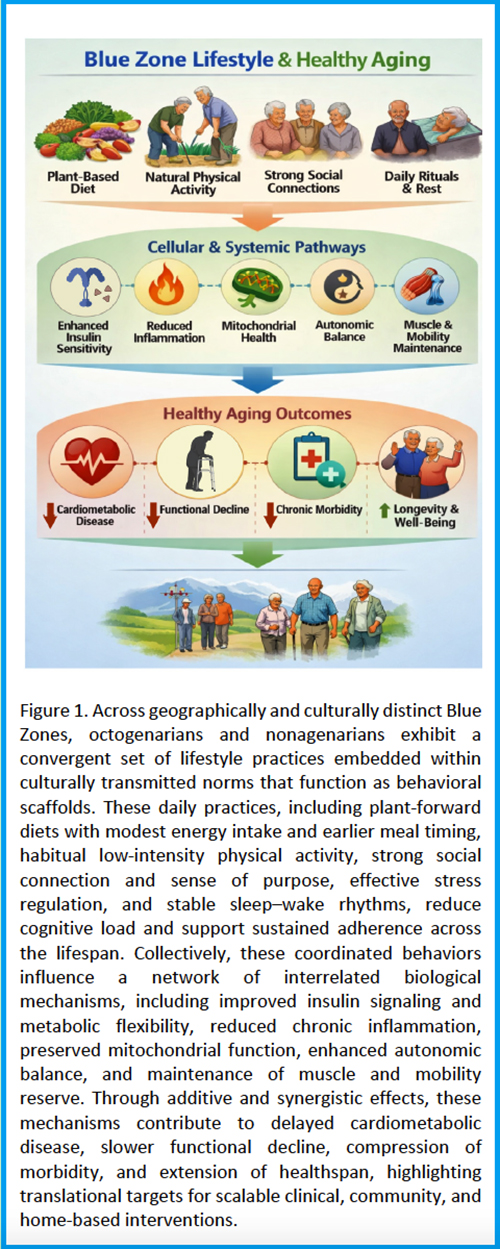
Across geographically and culturally diverse Blue Zones, octogenarians and nonagenarians share a strikingly consistent set of lifestyle patterns that appear to contribute to their exceptional longevity and preserved function, offering a natural model of successful aging in the very old (1). Despite differences in culture and environment, these individuals typically follow plant-forward, minimally processed diets centered on legumes, vegetables, whole grains, and healthy fats, with occasional modest portions of animal protein. Meals are typically moderate in energy and tend to occur earlier in the day, limiting late-evening caloric intake. These patterns are often embedded in culturally transmitted norms, such as the Okinawan concept of ikigai (sense of purpose), moai (stable social support networks), and hara hachi bu (mindful caloric moderation) (2). These culturally embedded practices often function as ‘behavioral scaffolds’ that facilitate sustained adherence to health-promoting behaviors by reducing cognitive load, decision fatigue, and reliance on individual motivation. Physical activity is not structured as formal exercise but is woven into daily life through walking, gardening, household tasks, and purposeful movement, characterized by high-frequency, low-intensity activity, frequent weight-bearing and postural challenges, minimal prolonged sedentary behavior, and sustained engagement across the lifespan (3). Equally important are strong psychosocial protective factors, including close social ties, multigenerational engagement, meaningful daily roles, and a clear sense of purpose, factors that are consistently associated with lower mortality risk, reduced inflammation, and better cognitive and emotional health in later life (4). These individuals also show effective stress regulation through simple daily rituals, such as prayer, brief rest periods, and communal gatherings, and maintain relatively stable sleep–wake and circadian patterns characterized by regular schedules, early light exposure, and minimal nocturnal disruption (4).These coordinated lifestyle habits are proposed to influence a network of interrelated cellular and systemic mechanisms, including improved insulin signaling and metabolic flexibility, attenuation of chronic inflammatory pathways, preservation of mitochondrial function and bioenergetic capacity, enhanced autonomic balance, and maintenance of muscle and mobility reserve, thereby delaying cardiometabolic disease, slowing functional decline, and compressing morbidity (5). Collectively, these convergent lifestyle factors represent modifiable daily practices with translational potential for practical, scalable interventions delivered through clinical settings, community programs, and home-based or digital platforms. Intervention fidelity can be tracked using pragmatic measures, including diet quality, eating window duration, daily steps and sedentary breaks, sleep regularity, and brief assessments of social connection and purpose, with outcomes spanning cardiometabolic risk, systemic inflammation, physical function, mobility, and patient-reported well-being. This framework posits that coordinated modification of multiple lifestyle domains yields additive or synergistic effects on metabolic and functional resilience, consistent with an ecological model of behavior in which health-related practices operate as interconnected and mutually reinforcing components rather than isolated behaviors, supporting extension of healthspan and population-level healthy aging.

Abs016.jpg

Downloads

Download data is not yet available.

1. Buettner D, Skemp S. Blue Zones: Lessons From the World's Longest Lived. Am J Lifestyle Med. 2016;10:318-321; https://doi.org/10.1177/1559827616637066.

2. Pes GM, Dore MP, Tsofliou F, Poulain M. Diet and longevity in the Blue Zones: A set-and-forget issue? Maturitas. 2022;164:31-37; https://doi.org/10.1016/j.maturitas.2022.06.004.

3. Herbert C, House M, Dietzman R, Climstein M, Furness J, Kemp-Smith K. Blue Zones: Centenarian Modes of Physical Activity: A Scoping Review. Journal of Population Ageing. 2022;18:5-41; https://doi.org/10.1007/s12062-022-09396.

4. Kreouzi M, Theodorakis N, Constantinou C. Lessons Learned From Blue Zones, Lifestyle Medicine Pillars and Beyond: An Update on the Contributions of Behavior and Genetics to Wellbeing and Longevity. Am J Lifestyle Med. 2024;18:750-765; https://doi.org/10.1177/15598276221118494.

5. Aliberti SM, Capunzo M. The Power of Environment: A Comprehensive Review of the Exposome's Role in Healthy Aging, Longevity, and Preventive Medicine-Lessons from Blue Zones and Cilento. Nutrients. 2025;17;

https://doi.org/10.3390/nu17040722.

How to Cite


1.
Anton S. Abstract 016 | Commonalities in lifestyle factors among octogenarians: Stephen Anton | Department of Physiology and Aging, College of Medicine, University of Florida, Gainesville, FL, USA. Eur J Transl Myol [Internet]. 2026 Mar. 2 [cited 2026 Apr. 14];36(s1). Available from: https://www.pagepressjournals.org/bam/article/view/15015