Abstracts of the 22nd Meeting of the Interuniversity Institute of Myology
Vol. 36 No. s1 (2026): Abstract book of the Padua Days on Muscle and Mobility Medicine 2026
https://doi.org/10.4081/ejtm.2026.15007

Abstract 008 | Functional and structural specialization of human donor tendons

Jan Fridén 1, Richard L. Lieber 2|3|4 | 1Swiss Paraplegic Center Nottwil, Switzerland; 2Northwestern University, Chicago USA; 3Shirley Ryan AbilityLab, Chicago USA; 4Hines VA Medical Center, Chicago USA.

Publisher's note
All claims expressed in this article are solely those of the authors and do not necessarily represent those of their affiliated organizations, or those of the publisher, the editors and the reviewers. Any product that may be evaluated in this article or claim that may be made by its manufacturer is not guaranteed or endorsed by the publisher.
Received: 2 March 2026
Published: 2 March 2026
106
Views
45
Downloads

Authors

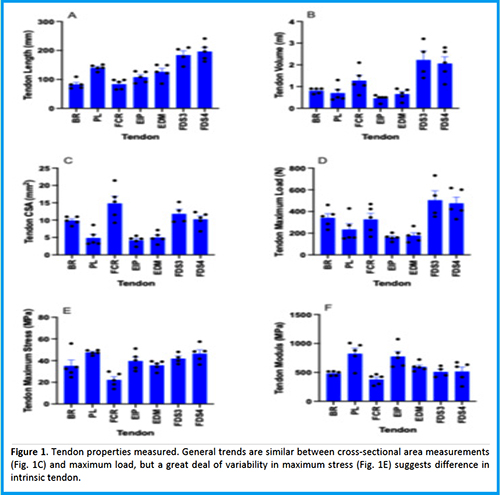
Consideration of the physiological properties of skeletal muscles in upper extremity surgery is appropriate since it is important to match donor and acceptor muscle functional properties. Thus, typically, tendon transfer surgery focuses on donor muscle properties, for example their expendability, excursion, force generation capacity and route of transfer (1). Less consideration is given to structural and functional properties of the tendons that transmit force from muscle to bone. However, it should be remembered that all muscles in vivo are actually muscle-tendon units and it has been shown that tendon properties can vary based on the function of the associated muscle (2). Which donor tendon should be used in reconstructive procedures? Typically, the more distal the reconstruction, the more specific are the tendon property requirements. For example, restoring intrinsic hand function necessitates smaller tendon diameters while the stiffness of these tendons must be relatively high to accurately transmit length change from muscle to bone thus providing fine motor control. During graft harvest, the surgeon applies their judgment to choose the most appropriate tendon donor (3). Tendons most commonly used in forearm and hands are palmaris longus (PL), plantaris, extensor indicis proprius (EIP) and extensor digiti minimi (EDM). Donor choice depends on the length of tendon needed, donor expendability, ease of harvest, donor site morbidity and surgeon preference. Previous studies described the morphology and biomechanical properties of several tendons commonly used as graft donors, focusing primarily on PL, plantaris and EIP2. Here we extend these studies to provide additional information on the morphology and biomechanics of several other relevant tendons commonly used as graft donors, PL, EIP, flexor digitorum superficialis to the third and fourth finger (FDS3, FDS4), EDM, brachioradialis (BR) and flexor carpi radialis (FCR). Fresh-frozen cadaveric upper limbs amputated at the mid-humeral level were used (n = 5; 2 right, left; 2 male, 3 female; average age = 72.8 years). The length from the lateral epicondyle to the radial styloid indicated arm size (263 ± 9.8, n=5). Dissection identified BR, FCR, PL, EIP, EDM, FDS to the ring finger (FDS3), FDS to the small finger (FDS4) and FDP to the index (FDP-I) tendons from origin to insertion. Proximal transection occurred at the most distal extent of the musculo-tendinous junction. Tendon mechanical properties were measured using a tensile testing machine (Instron Model 5565A; Instron, Norwood, MA) equipped with a 5000N load cell and clamps separated by at least 5 cm to allow adequate clamp purchase. Testing consisted of 5 consecutive cycles to 5% strain followed by elongation at 10 mm/min to failure. Testing was stopped after observing a 30% drop from peak force. Variables considered were maximum load, stiffness, and Young’s modulus. Tendons exhibited a wide variety of morphological (Fig. 1A, 1B, 1C) and biomechanical (Fig. 1D, 1E, 1F) properties. One-way ANOVA demonstrated that all tendons showed statistically significant differences in length, volume, cross-sectional area, maximum load, ultimate stress, and modulus. FDS4 was the longest tendon (236 ± 20 mm), but FDS3 had the greatest volume (2.2 ± 0.4 cm3) and FCR had the greatest CSA (15.3 ± 1.3 mm2). Although FDS3 withstood the greatest maximum load before failure (504 ± 87 N), there was no significant difference between this load and the loads borne by FDS4, BR, FDP-I, and FCR. FCR also bore the lowest stress at maximum load (22.3 ± 3.0 MPa) and was the most compliant tendon, as demonstrated by its low modulus (377 ± 39 MPa,). The three stiffest tendons (and their modulus values) were PL (823 ± 95 MPa), followed by EIP (776 ± 86 MPa) and EDM (625 ± 41 MPa). This study demonstrates that forearm tendons are morphologically diverse with quite different mechanical properties that are not obvious simply based on their morphology. In other words, smaller tendons are not necessarily intrinsically weaker. These data are applicable to both tendon transfer and grafting procedures. Variations in tendon structure and biomechanics may influence how and which tendons are selected for these procedures. For example, use of FCR for transfer to lumbricals to restore intrinsics balance may be a suboptimal choice. Application to specific reconstructive procedures of the hand and arm will be illustrated by specific cases.

Abs008.jpg

Downloads

Download data is not yet available.

1. Friden J, Lieber RL. Reach out and grasp the opportunity: reconstructive hand surgery in tetraplegia. J Hand Surg (Eur Vol.) 2019;44:343-53. DOI: https://doi.org/10.1177/1753193419827814

2. Shadwick R. Elastic energy storage in tendons: mechanical differences related to function and age. American Journal of Physiology. 1990;207:1033-40. DOI: https://doi.org/10.1152/jappl.1990.68.3.1033

3. Fridén J, Lieber RL. Mechanical considerations in the design of surgical reconstructive procedures. J Biomech. 2002;35:1039-45. DOI: https://doi.org/10.1016/S0021-9290(02)00045-3

How to Cite


1.
Fridén J. Abstract 008 | Functional and structural specialization of human donor tendons: Jan Fridén 1, Richard L. Lieber 2|3|4 | 1Swiss Paraplegic Center Nottwil, Switzerland; 2Northwestern University, Chicago USA; 3Shirley Ryan AbilityLab, Chicago USA; 4Hines VA Medical Center, Chicago USA. Eur J Transl Myol [Internet]. 2026 Mar. 2 [cited 2026 Apr. 17];36(s1). Available from: https://www.pagepressjournals.org/bam/article/view/15007