Abstracts of the 22nd Meeting of the Interuniversity Institute of Myology
Vol. 36 No. s1 (2026): Abstract book of the Padua Days on Muscle and Mobility Medicine 2026
https://doi.org/10.4081/ejtm.2026.15001

Abstract 002 | Muscle and brain dysfunction associated with modern critical care. Mechanisms and interventions

Lars Larsson 1|2 | 1Department of Clinical Sciences, SLU, Uppsala, Sweden; 2Muscle Biology Program, Viron Molecular Medicine Institute, Boston, MA, USA.

Publisher's note
All claims expressed in this article are solely those of the authors and do not necessarily represent those of their affiliated organizations, or those of the publisher, the editors and the reviewers. Any product that may be evaluated in this article or claim that may be made by its manufacturer is not guaranteed or endorsed by the publisher.
Received: 2 March 2026
Published: 2 March 2026
121
Views
36
Downloads

Authors

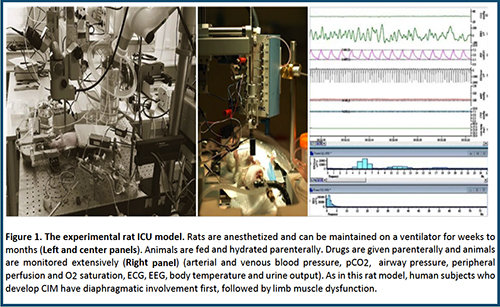
Intensive care units (ICUs) have undergone significant development resulting in higher survival rates, primarily due to improved medical technologies, progress in therapies, and the introduction of evidence-based medicine. However, survivors often experience long-term or permanent sequelae of brain, lung and muscle dysfunction that negatively impact on quality of life and the ability to function in society (1, 2). The muscle weakness, mobility limitations, cognitive impairment, and mental health symptoms are collectively referred to as post-intensive care syndrome (PICS)(3, 4). Approximately 30% (100% in some subpopulations) of the general ICU population develop Critical Illness Myopathy (CIM) with general paralysis of all limb and trunk muscles, increasing ICU stay and costs by 30% (not including additional post-ICU care and rehabilitation costs) (5-7). Approximately 40% of the time ICU patients are mechanically ventilated is devoted to weaning off the ventilator due to Ventilator Induced Diaphragm Dysfunction (VIDD) and associated with a 20-30% increased risk of morbidity/mortality and a staggering increase in overall ICU costs. In addition, cognitive impairment and delirium are common in long-term mechanically ventilated ICU patients with a prevalence ranging between 70% and 100 % at hospital discharge (8) which may resolve in some patients but persistent cognitive impairment or acquired dementia are observed in others (9). Our experimental and clinical studies together with preliminary unpublished results suggest that mechanical ventilation induced lung injury (VILI) and the release of cytotoxic factors and cytokines from lung endothelial cells released systemically underly the brain and muscle dysfunction associated with critical care, where underlying disease may worsen the dysfunction but does not represent causal pathophysiological factors. The complete mechanical silencing (loss of external strain induced by weight bearing and internal strain linked to activation of contractile proteins), uniquely observed in deeply sedated or pharmacologically paralyzed ICU patients, has an additive negative impact on limb skeletal muscle structure and function. It is hypothesized that the complete mechanical silencing and the release of toxic factors from the lung associated with positive pressure mechanical ventilation are dominant factors underlying the muscle and brain dysfunction associated with modern critical care. Our overarching goal of this project is to reduce the negative effects of the ICU condition per se on brain, lung and muscle. Clinical studies are hampered by different confounding factors related to age, gender, underlying disease, polypharmacy etc. However, investigating underlying mechanisms and intervention strategies induced by long-term exposure to the ICU condition per se in the absence of confounding disease is unethical in clinical studies. Experimental models allowing long-term observation periods are therefore needed since the iatrogenic consequences of modern critical care are strongly associated with the duration of the ICU condition. Further, the ICU condition represents a complex biological system including mechanical ventilation, immobilization and organ-to-organ communication which cannot be replicated in models in vitro. In the current project we have used a unique experimental ICU (ExICU) model where rats are deeply sedated, pharmacologically paralyzed and extensively monitored (Figure 1). This model has been used to unravel underlying mechanisms in time-resolved analyses from 0 to 14 days exposure to the ICU condition as well as in the evaluation of different interventions targeting the mechanical silencing and CIM/VIDD/VILI and most recently also the ventilator associated brain dysfunction.

Abs002.jpg

Downloads

Download data is not yet available.

1. Herridge MS, Azoulay E. Outcomes after Critical Illness. N Engl J Med 2023; 388: 913–924. DOI: https://doi.org/10.1056/NEJMra2104669

2. Herridge MS, Cheung AM, Tansey CM, Matte-Martyn A, Diaz-Granados N, Al-Saidi F, Cooper AB, Guest CB, Mazer CD, Mehta S, Stewart TE, Barr A, Cook D, Slutsky AS. One-year outcomes in survivors of the acute respiratory distress syndrome. N Engl J Med 2003; 348: 683–693. DOI: https://doi.org/10.1056/NEJMoa022450

3. Needham DM, Davidson J, Cohen H, Hopkins RO, Weinert C, Wunsch H, Zawistowski C, Bemis-Dougherty A, Berney SC, Bienvenu OJ, Brady SL, Brodsky MB, Denehy L, Elliott D, Flatley C, Harabin AL, Jones C, Louis D, Meltzer W, Muldoon SR, Palmer JB, Perme C, Robinson M, Schmidt DM, Scruth E, Spill GR, Storey CP, Render M, Votto J, Harvey MA. Improving long-term outcomes after discharge from intensive care unit: report from a stakeholders' conference. Crit Care Med 2012; 40: 502–509. DOI: https://doi.org/10.1097/CCM.0b013e318232da75

4. Latronico N, Eikermann M, Ely EW, Needham DM. Improving management of ARDS: uniting acute management and long-term recovery. Crit Care 2024; 28: 58. DOI: https://doi.org/10.1186/s13054-024-04810-9

5. Friedrich O, Reid MB, Van den Berghe G, Vanhorebeek I, Hermans G, Rich MM, Larsson L. The Sick and the Weak: Neuropathies/Myopathies in the Critically Ill. Physiol Rev 2015; 95: 1025–1109. DOI: https://doi.org/10.1152/physrev.00028.2014

6. Cacciani N, Skärlén, Å., Wen, Y., Zhang, X., Addinsall, A.B., Llnano-Diez, M., Li, M., Gransberg, L., Hedström, Y., Bellander, B.-M., Nelson, D., Bergquist, J., Larsson, L. A prospective clinical study on the mechanisms underlying Critical Illness Myopathy – A time-course approach. Journal of cachexia, sarcopenia and muscle 2022. DOI: https://doi.org/10.1002/jcsm.13104

7. Llano-Diez M, Renaud G, Andersson M, Marrero HG, Cacciani N, Engquist H, Corpeno R, Artemenko K, Bergquist J, Larsson L. Mechanisms underlying ICU muscle wasting and effects of passive mechanical loading. Crit Care 2012; 16: R209. DOI: https://doi.org/10.1186/cc11841

8. Wilcox ME, Brummel NE, Archer K, Ely EW, Jackson JC, Hopkins RO. Cognitive dysfunction in ICU patients: risk factors, predictors, and rehabilitation interventions. Crit Care Med 2013; 41: S81–98. DOI: https://doi.org/10.1097/CCM.0b013e3182a16946

9. Pandharipande PP, Girard TD, Jackson JC, Morandi A, Thompson JL, Pun BT, Brummel NE, Hughes CG, Vasilevskis EE, Shintani AK, Moons KG, Geevarghese SK, Canonico A, Hopkins RO, Bernard GR, Dittus RS, Ely EW, Investigators B-IS. Long-term cognitive impairment after critical illness. N Engl J Med 2013; 369: 1306–1316. DOI: https://doi.org/10.1056/NEJMoa1301372

How to Cite


1.
Larsson L. Abstract 002 | Muscle and brain dysfunction associated with modern critical care. Mechanisms and interventions: Lars Larsson 1|2 | 1Department of Clinical Sciences, SLU, Uppsala, Sweden; 2Muscle Biology Program, Viron Molecular Medicine Institute, Boston, MA, USA. Eur J Transl Myol [Internet]. 2026 Mar. 2 [cited 2026 Apr. 11];36(s1). Available from: https://www.pagepressjournals.org/bam/article/view/15001