
 https://doi.org/10.4081/ecj.2026.15960
20 | Clinical application of the new global definition of acute respiratory distress syndrome in a case of fat embolism syndrome
All claims expressed in this article are solely those of the authors and do not necessarily represent those of their affiliated organizations, or those of the publisher, the editors and the reviewers. Any product that may be evaluated in this article or claim that may be made by its manufacturer is not guaranteed or endorsed by the publisher.
Introduction. The new global definition of Acute Respiratory Distress Syndrome (ARDS) allows diagnosis in patients receiving High-Flow Nasal Cannula (HFNC) therapy at flow rates ≥30 L/min and supports the SpO2/FiO2 (S/F) ratio as an alternative to the PaO2/FiO2 (P/F) ratio. It also recognizes Lung Ultrasound (LUS) as an imaging modality equivalent to CT or chest X-ray for identifying bilateral opacities, emphasizing its value for dynamic bedside monitoring of disease progression and recovery. We report a case of Fat Embolism Syndrome (FES) evolving into moderate ARDS, managed exclusively with HFNC and monitored through an integrated ultrasonographic approach.
Methods. A 16-year-old male was admitted to the Intensive Care Unit (ICU) for hypoxemia that developed after a post-traumatic diaphyseal femur fracture. On admission, on spontaneous ventilation before the initiation of HFNC, the S/F ratio was 224. Chest CT revealed bilateral alveolar infiltrates consistent with ARDS. HFNC was started (initial flow 55 L/min, FiO₂ 0.5), with serial monitoring of P/F and S/F ratios. A systematic 8-zone diagnostic lung ultrasound was also performed with a convex low frequency probe and the lung ultrasound computed for each zone.
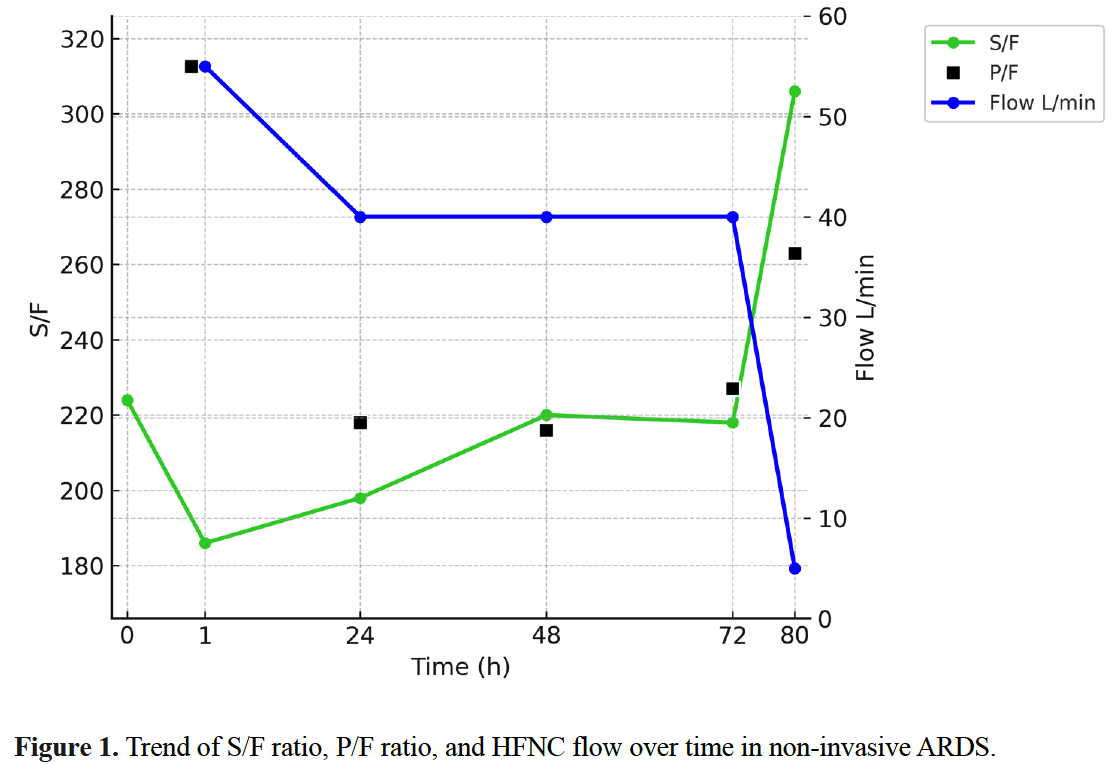
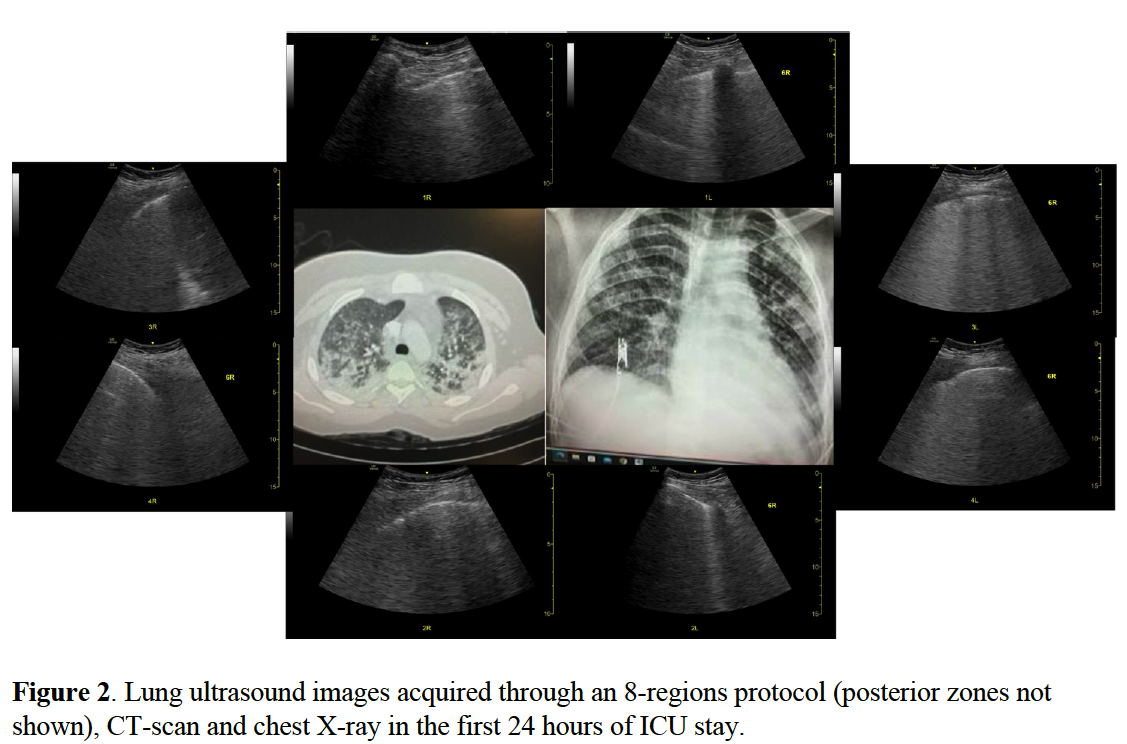
Results. Following HFNC initiation, oxygenation progressively improved. The P/F ratio increased from 138 to 262 mmHg, while the S/F ratio rose from 186 to 306, with parallel trajectories accompanying the gradual reduction of support (Figure 1) and the HFNC flow was decreased from 60 to 40 L/min in accordance with clinical and gasometric improvement. Lung ultrasound demonstrated a distinct interstitial pattern with multiple B-lines with a global LUS score of 14, consistent with CT and chest X-ray findings (Figure 2). The clinical course was favorable, with complete HFNC weaning by day 5 and discharge on day 6.
Conclusions. Implementation of the new global definition is especially useful in post-traumatic ARDS in young patients, for whom a tube-sparing strategy is encouraged - and in resource-limited settings with restricted access to blood gas analysis and imaging. Benefits are also envisaged in terms of limiting serial arterial blood gas sampling and iatrogenic anemia in the ICU. This case exemplifies its practical application, showing how integrating HFNC, S/F ratio, and lung ultrasound enables early diagnosis and effective non-invasive management.
Downloads
-
How to Cite

This work is licensed under a Creative Commons Attribution-NonCommercial 4.0 International License.
PAGEPress has chosen to apply the Creative Commons Attribution NonCommercial 4.0 International License (CC BY-NC 4.0) to all manuscripts to be published.