 https://doi.org/10.4081/ecj.2026.15948
13 | Veno-arterial extracorporeal membrane oxygenation as a bridge to decision in an adult patient with uncorrected tetralogy of Fallot
All claims expressed in this article are solely those of the authors and do not necessarily represent those of their affiliated organizations, or those of the publisher, the editors and the reviewers. Any product that may be evaluated in this article or claim that may be made by its manufacturer is not guaranteed or endorsed by the publisher.
Background. Advances in diagnostics and therapy have markedly improved the survival of patients with congenital heart disease, many of whom reach adulthood. However, those with uncorrected lesions remain at high risk of cardiopulmonary decompensation. In the setting of refractory hypoxemia and cardiogenic shock, Extracorporeal Membrane Oxygenation (ECMO) may provide life-saving support. The choice between Veno-Venous (V-V) and Veno-Arterial (V-A) configuration must be guided by the underlying cardiac anatomy and shunt physiology.
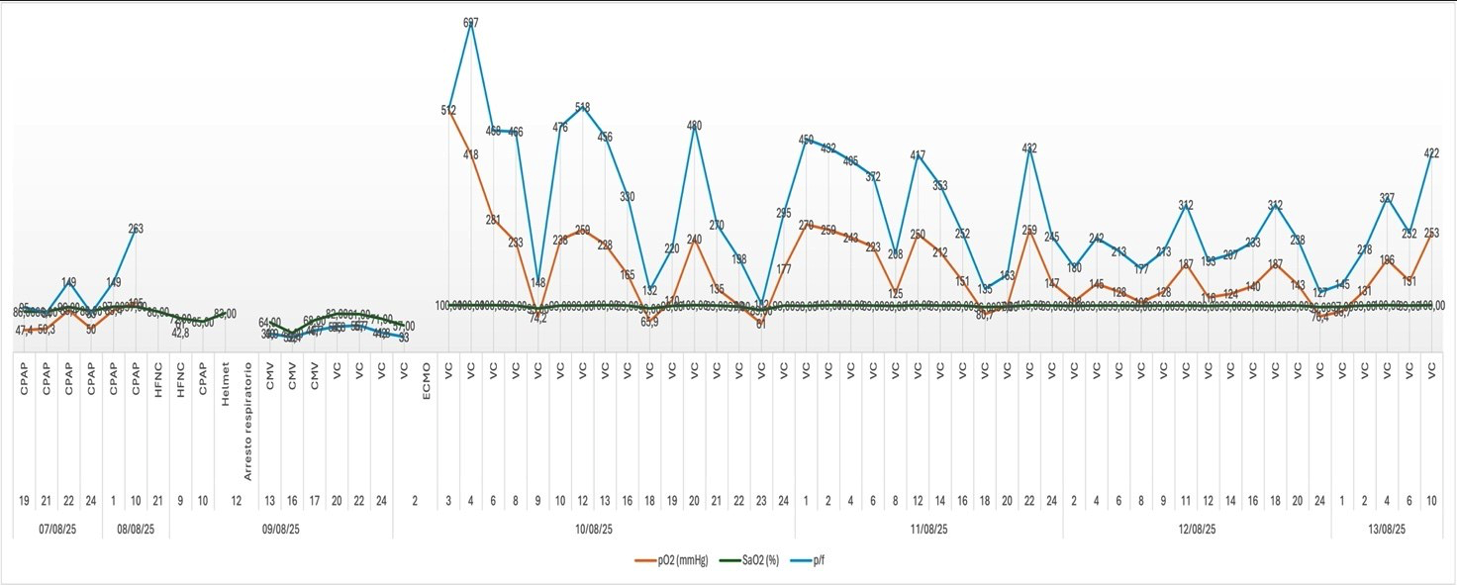
Methods. In the ICU of the University Hospital of Sassari, a 60-year-old woman with uncorrected Tetralogy of Fallot (TOF), palliated by valvulotomy and Blalock-Taussig shunt in infancy, was admitted with bilateral pneumonia and ARF. Her history included severe COPD and refusal of definitive correction in 2023. Despite broad-spectrum antibiotics and non-invasive ventilation (CPAP, HFNC), oxygenation worsened (PaO₂/FiO₂≈50) leading to respiratory arrest and cardiogenic shock. Echocardiography revealed right ventricular dilation and dysfunction, a perimembranous Ventricular Septal Defect (VSD) with right-to-left shunt, and severe infundibular pulmonary stenosis (mean gradient 56 mmHg).
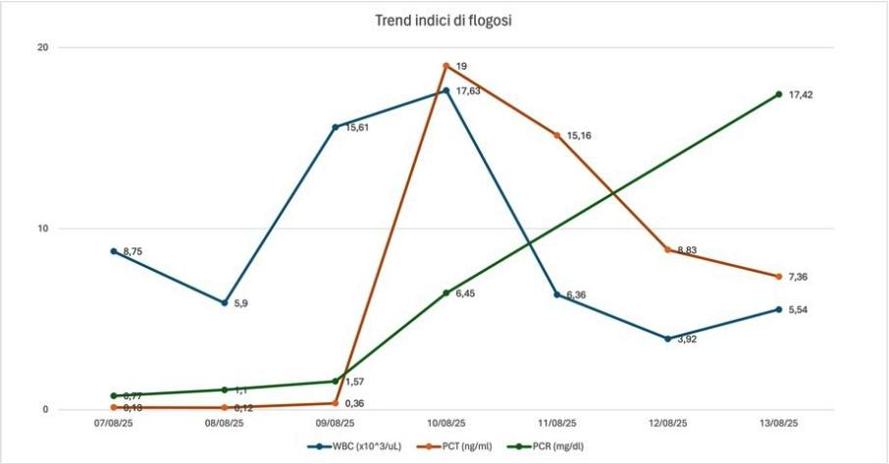
Results. Given the presence of an intracardiac shunt, V-V ECMO was contraindicated as it would have worsened systemic hypoxemia by recirculating poorly oxygenated blood through the right-to-left pathway. Peripheral V-A ECMO was therefore initiated via femoral vessels (flow 50-60% of theoretical). Inotropic and vasopressor support (dobutamine, norepinephrine, vasopressin) were gradually tapered as hemodynamic stabilized. Under analgosedation and protective ventilation, gas exchange and systemic oxygenation improved. Neurological function remained intact. Minor mucosal bleeding and transient atrial fibrillation were managed conservatively. After four days, with stable hemodynamic and improved inflammatory indices, the patient was safely transferred to a referral cardiac surgery centre.
Conclusions. In adults with uncorrected TOF and right-to-left shunt, severe hypoxemia secondary to pneumonia may mimic isolated respiratory failure, but V-V ECMO can exacerbate desaturation. V-A ECMO provides both circulatory support and systemic oxygen delivery; however, due to complex cardiopulmonary physiology and potential flow inversion associated with changes in pulmonary vascular resistance, its application does not necessarily guarantee immediate improvement in oxygen saturation. In non-cardiac surgery centers, early recognition of shunt dynamics and tailored ECMO strategy are essential to ensure stabilization and improve survival in this high-risk population.
Downloads
-
CRediT authorship contribution
Supporting Agencies
Data Availability Statement
How to Cite

This work is licensed under a Creative Commons Attribution-NonCommercial 4.0 International License.
PAGEPress has chosen to apply the Creative Commons Attribution NonCommercial 4.0 International License (CC BY-NC 4.0) to all manuscripts to be published.