 https://doi.org/10.4081/ecj.2026.15945
10 | Emergency bronchoscopy: experience from a spoke center without a dedicated service
All claims expressed in this article are solely those of the authors and do not necessarily represent those of their affiliated organizations, or those of the publisher, the editors and the reviewers. Any product that may be evaluated in this article or claim that may be made by its manufacturer is not guaranteed or endorsed by the publisher.
Introduction. Flexible Bronchoscopy (FBS) is an essential diagnostic-therapeutic procedure in critical care, useful for treating airway obstructions and respiratory infections, in microbiological sampling and optimisation of diagnostic and therapeutic strategies. In literature it is demonstrated that FBS performed in Emergency Department (ED) and in Sub-Intensive Care units (SICU), when carried out by trained emergency physicians in an appropriate setting, improves clinical outcomes with a low complication rate. Based on this evidence, we developed a project to implement FBS within A&E and SICU of our hospital, which lacks a dedicated endoscopic service.
Methods. The study began in March 2025 with the development of a structured theoretical and practical training program for a multidisciplinary team of physicians, nurses, and Healthcare Assistants (HCA) working in sub-intensive care, enabling them to perform FBS in emergency settings. FBS was carried out within approximately 72 hours from patient’s admission to ED or SICU, using a dedicated room equipped with both reusable and single-use flexible bronchoscopes, a video monitor, suction system for microbiological sample collection, and continuous multi-parameter monitoring. In each procedure two teams were involved: one team responsible for performing FBS, consisting of two physicians, one nurse and one HCA; another dedicated to sedation and patient monitoring composed by one emergency physician and one nurse. For each patient, data were collected regarding indication, characteristics and timing of procedure, use of procedural sedation, diagnostic outcome and possible complications. Finally, the study evaluated the impact of this procedure on the diagnostic and therapeutic handling of the patient.
Results. From 12 March 2025 to 28 October 2025 21 bronchoscopies were performed. The results are reported in the table below.
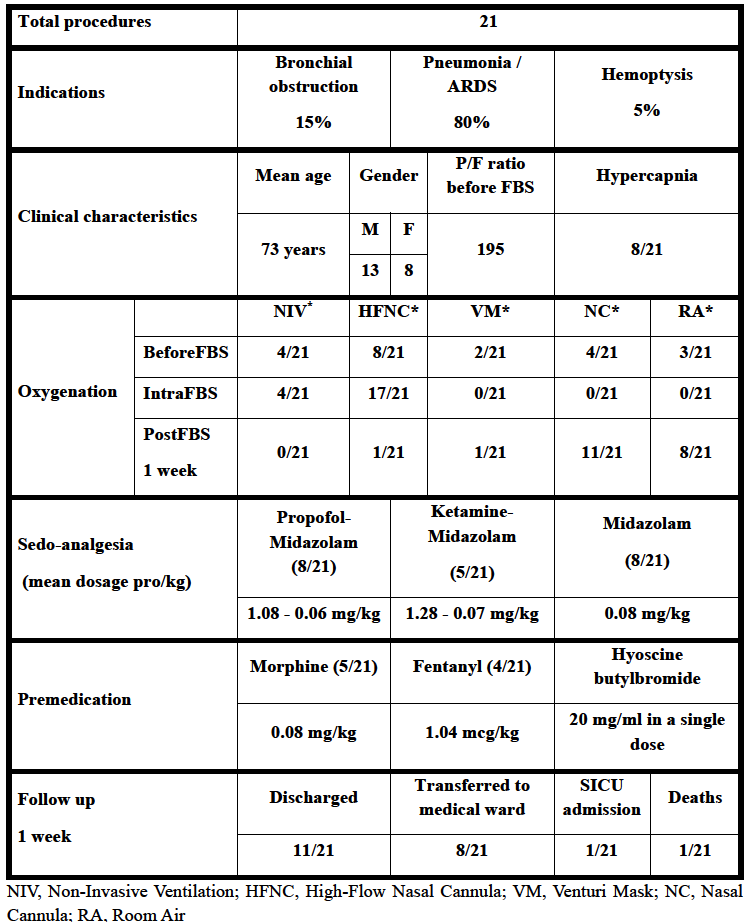
The average procedural time was approximately 16 minutes and all complications were mild, temporary, and self-limiting, with no major adverse events reported (pneumothorax, severe hemodynamic instability, refractory hypoxemia, or early post-procedural death). Each procedure was preceded by procedural sedation allowing an average level of sedation between –2 and –3 according to the Richmond Agitation Sedation Scale (RASS) without any significant adverse event. Bronchoalveolar Lavage (BAL) yielded significant cultures in 75% of cases, leading to the adjustment of antibiotic therapy in 40% of patients and a reduction in oxygen requirement.
Conclusions. Our experience confirms that FBS performed in the ED/SICU is a safe and effective procedure that enables timely targeted antibiotic therapy, improving clinical outcomes and the overall efficiency of the clinical care pathway. Observed complications were minimal, demonstrating that bronchoscopy carries no significant risk when performed by trained staff in an organised and well-equipped setting. Moreover, the ability to perform the procedure directly in peripheral settings ensures faster and more timely treatment of the condition, without the need to arrange transfers of critically ill and unstable patients to Hub centres, which can thus be restricted to second-level procedures or cases with high clinical risk.
Downloads
-
CRediT authorship contribution
Supporting Agencies
Data Availability Statement
How to Cite

This work is licensed under a Creative Commons Attribution-NonCommercial 4.0 International License.
PAGEPress has chosen to apply the Creative Commons Attribution NonCommercial 4.0 International License (CC BY-NC 4.0) to all manuscripts to be published.