
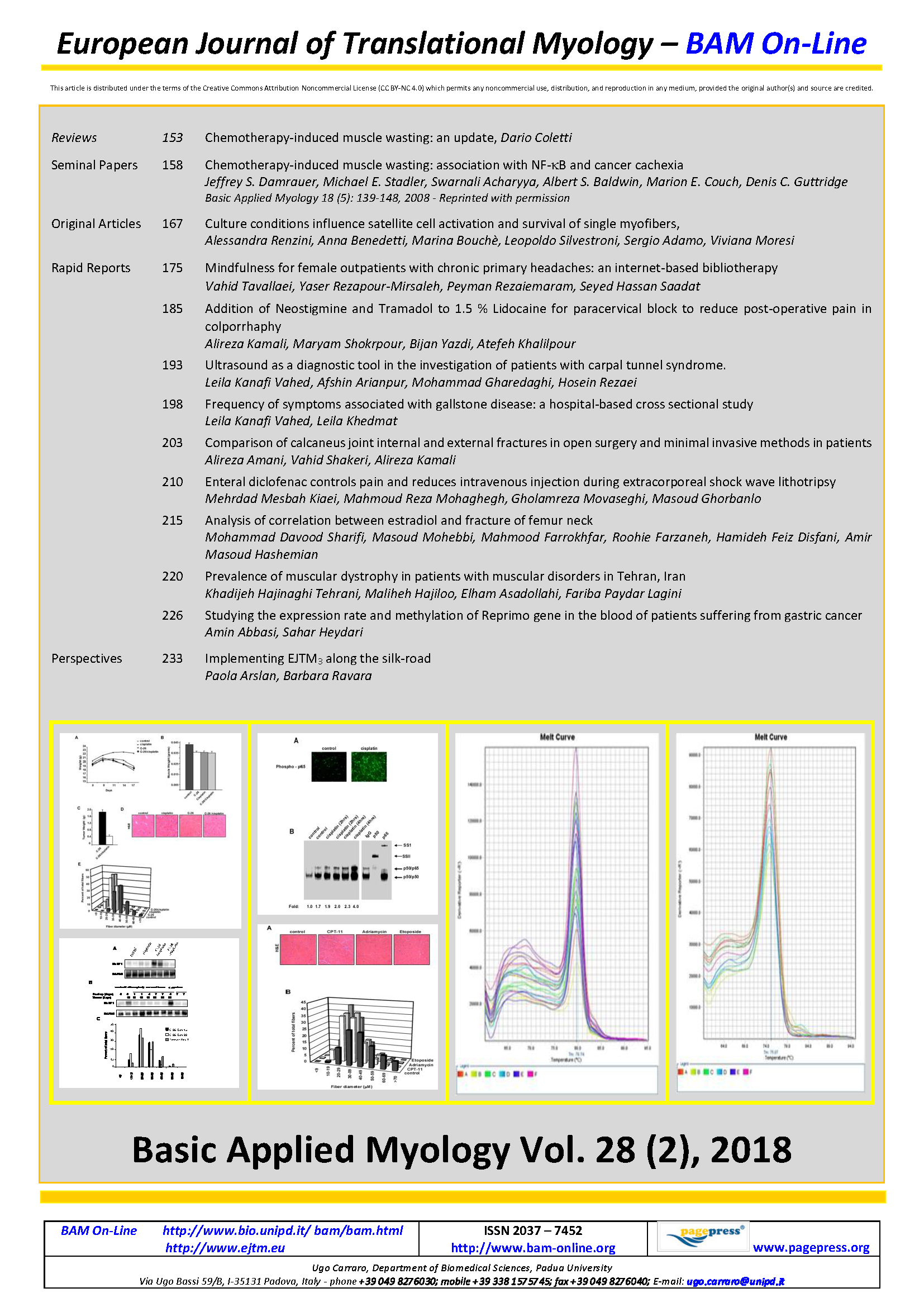
Seminal Papers: BAM Reprints
Vol. 28 No. 2 (2018)
 https://doi.org/10.4081/ejtm.2018.7590
Chemotherapy-induced muscle wasting: association with NF-κB and cancer cachexia

Publisher's note
All claims expressed in this article are solely those of the authors and do not necessarily represent those of their affiliated organizations, or those of the publisher, the editors and the reviewers. Any product that may be evaluated in this article or claim that may be made by its manufacturer is not guaranteed or endorsed by the publisher.
All claims expressed in this article are solely those of the authors and do not necessarily represent those of their affiliated organizations, or those of the publisher, the editors and the reviewers. Any product that may be evaluated in this article or claim that may be made by its manufacturer is not guaranteed or endorsed by the publisher.
Received: 5 June 2018
Accepted: 5 June 2018
Published: 6 June 2018
Accepted: 5 June 2018
Published: 6 June 2018
3996
Views
1948
Downloads
211
HTML
Downloads
Download data is not yet available.
How to Cite
1.
Damrauer JS, Stadler ME, Acharyya S, Baldwin AS, Couch ME, Guttridge DC. Chemotherapy-induced muscle wasting: association with NF-κB and cancer cachexia. Eur J Transl Myol [Internet]. 2018 Jun. 6 [cited 2026 Oct. 16];28(2). Available from: https://www.pagepressjournals.org/bam/article/view/7590
PAGEPress has chosen to apply the Creative Commons Attribution NonCommercial 4.0 International License (CC BY-NC 4.0) to all manuscripts to be published.