
 https://doi.org/10.4081/gc.2023.11377
Symmetrical peripheral gangrene in a patient with septic shock and a multi-drug resistant Klebsiella pneumoniae infection
All claims expressed in this article are solely those of the authors and do not necessarily represent those of their affiliated organizations, or those of the publisher, the editors and the reviewers. Any product that may be evaluated in this article or claim that may be made by its manufacturer is not guaranteed or endorsed by the publisher.
Accepted: 26 July 2023
Published: 28 August 2023
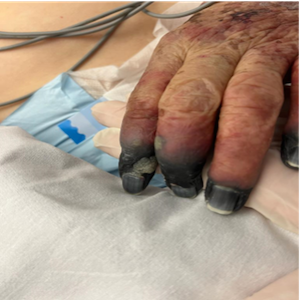
Symmetrical peripheral gangrene (SPG) can sometimes occur without definite disseminated intravascular coagulation. The differential diagnosis comprises the exclusion of many non-infectious diseases and the effort to isolate the microbic agent in the case of septic shock. Between bacterial causes, Klebsiella pneumoniae is one of the bacteria that can trigger SPG through hypervirulence and hypercoagulopathy mechanisms. We report a case of SPG associated with septic shock and a multi-drug resistant K. pneumoniae infection.
Downloads
Warkentin TE. Ischemic limb gangrene with pulses. N Engl J Med 2015;373:642-55. DOI: https://doi.org/10.1056/NEJMra1316259
Foead AI, Mathialagan A, Varadarajan R, Larvin M. Management of symmetrical peripheral gangrene. Indian J Crit Care Med 2018;22:870-4. DOI: https://doi.org/10.4103/ijccm.IJCCM_379_18
WHO. Global Priority List of Antibiotic-resistant Bacteria to Guide Research, Discovery, and Development of New Antibiotics. Available from: https://www.quotidianosanita.it/allegati/allegato4135670.pdf.
Kashyap R, Behl RK, Mahajan S, et al. Symmetrical peripheral gangrene due to viral gastroenteritis. J Assoc Physicians India 2004;52:500-1.
Yoo J, Min J, Kwon S, et al. Symmetrical peripheral gangrene complicating klebsiella pneumoniae sepsis associated with antiphospholipid antibodies. Ann Rheum Dis 2004;63:459-60. DOI: https://doi.org/10.1136/ard.2003.012542
Kamal F, Williams G, Akbar H, et al. Klebsiella pneumoniae liver abscess: a case report and review of literature. Cureus 2017;9:e970. DOI: https://doi.org/10.7759/cureus.970
How to Cite

This work is licensed under a Creative Commons Attribution-NonCommercial 4.0 International License.
PAGEPress has chosen to apply the Creative Commons Attribution NonCommercial 4.0 International License (CC BY-NC 4.0) to all manuscripts to be published.