
 https://doi.org/10.4081/aiua.2026.15728
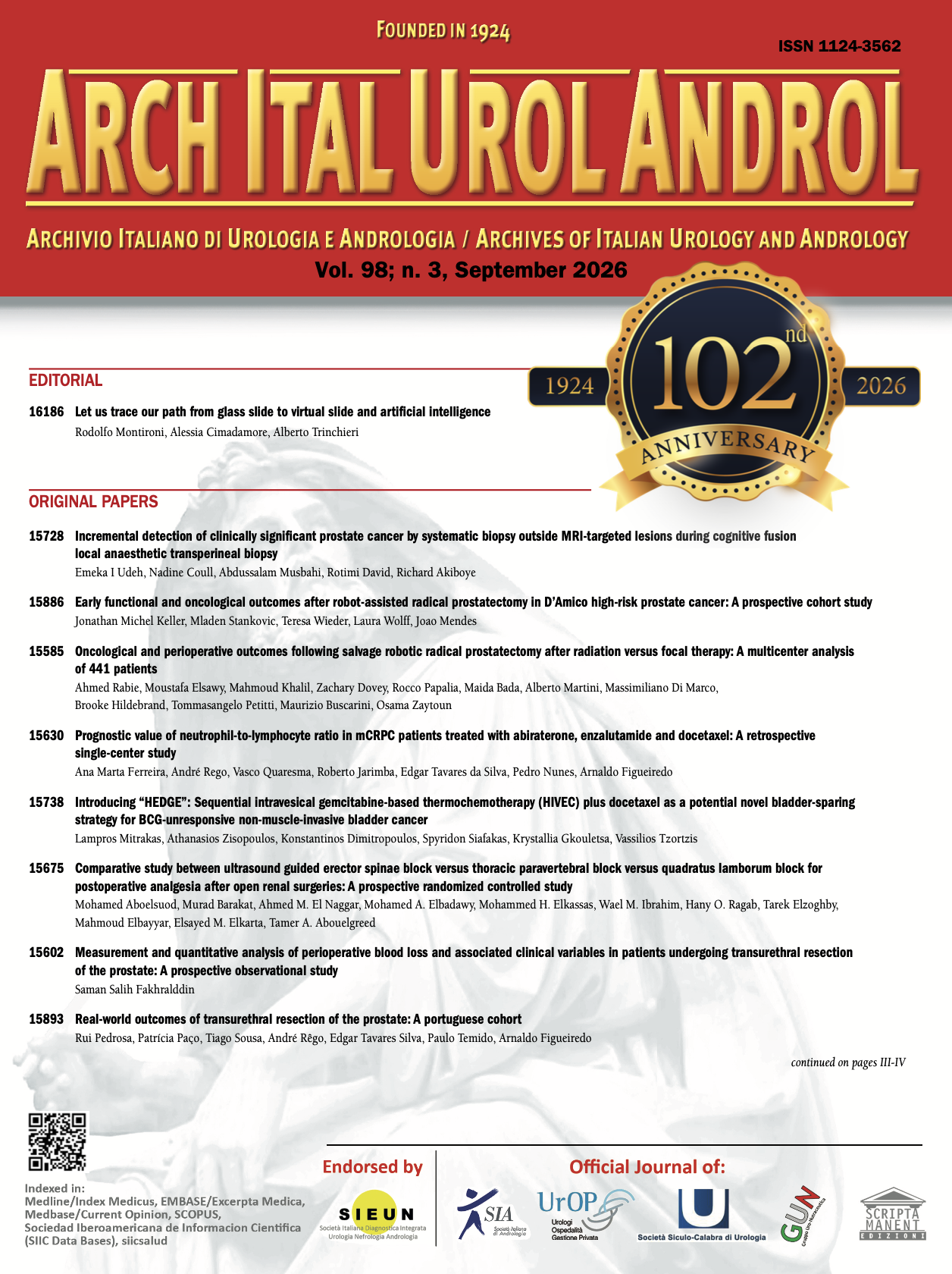
Incremental detection of clinically significant prostate cancer by systematic biopsy outside MRI-targeted lesions during cognitive fusion local anaesthetic transperineal biopsy
All claims expressed in this article are solely those of the authors and do not necessarily represent those of their affiliated organizations, or those of the publisher, the editors and the reviewers. Any product that may be evaluated in this article or claim that may be made by its manufacturer is not guaranteed or endorsed by the publisher.
Accepted: 13 July 2026
Published: 7 September 2026
Objective: To evaluate the incremental yield of clinically significant prostate cancer (csPCa) detected by systematic biopsy outside MRI-targeted lesions during cognitive fusion local anaesthetic transperineal prostate biopsy.
Patients and methods: This observational cohort study included men undergoing cognitive MRI-targeted prostate biopsy with concurrent systematic sampling. Pre-biopsy MRI findings were recorded using PI-RADS. The primary outcome was csPCa detected exclusively by systematic biopsy outside MRI-targeted lesions despite a negative targeted biopsy. Secondary outcomes included csPCa detection by targeted, systematic, and combined biopsy, PI-RADS subgroup analysis, and multivariable predictors of csPCa.
Results: Overall, 770 men were included, of whom 767 had evaluable paired biopsy data. Most had PI-RADS 4 lesions (636/767, 82.9%). csPCa was detected by targeted biopsy in 320/767 men (41.7%), systematic biopsy outside MRI-targeted lesions in 196/767 (25.6%), and combined biopsy in 384/767 (50.1%). Exclusive outside-target systematic csPCa detection occurred in 64/767 men (8.3%), representing 16.7% of all csPCa detected. This rate was highest in PI-RADS 3 lesions (8/30, 26.7%). On multivariable analysis, overall csPCa detection was associated with age, PSA density, and PI-RADS score, whereas exclusive outside-target detection was inversely associated with PI-RADS score and positively associated with procedures performed by urologists. Spatial analysis showed that most systematic-only csPCa lesions were anatomically distinct from the index MRI-visible lesion.
Conclusions: Systematic biopsy outside MRI-targeted lesions detected additional csPCa in 64/767 men (8.3%) and frequently identified anatomically distinct lesions, supporting continued systematic sampling alongside MRI-targeted biopsy in selected patients.
Downloads
1. Mac Curtain BM, Temperley HC, Kelly JAO, et al. The role of urology and radiology in prostate biopsy: current trends and future perspectives. World J Urol 2024; 42:249. DOI: https://doi.org/10.1007/s00345-024-04967-6
2. Ippoliti S, Fletcher P, Orecchia L, et al. Optimal biopsy approach for detection of clinically significant prostate cancer. Br J Radiol 2022; 95:20210413. DOI: https://doi.org/10.1259/bjr.20210413
3. Ahdoot M, Wilbur AR, Reese SE, et al. MRI-Targeted, Systematic, and Combined Biopsy for Prostate Cancer Diagnosis. N Engl J Med 2020; 382:917-28. DOI: https://doi.org/10.1056/NEJMoa1910038
4. Devetzis K, Kum F, Popert R. Recent Advances in Systematic and Targeted Prostate Biopsies. Res Rep Urol 2021; Volume 13:799-809. DOI: https://doi.org/10.2147/RRU.S291963
5. Ahmed HU, El-Shater Bosaily A, Brown LC, et al. Diagnostic accuracy of multi-parametric MRI and TRUS biopsy in prostate cancer (PROMIS): a paired validating confirmatory study. The Lancet 2017; 389:815-22. DOI: https://doi.org/10.1016/S0140-6736(16)32401-1
6. Kasivisvanathan V, Rannikko AS, Borghi M, et al. MRI-Targeted or Standard Biopsy for Prostate-Cancer Diagnosis. N Engl J Med 2018; 378:1767-77. DOI: https://doi.org/10.1056/NEJMoa1801993
7. Klingebiel M, Arsov C, Ullrich T, et al. Reasons for missing clinically significant prostate cancer by targeted magnetic resonance imaging/ultrasound fusion-guided biopsy. Eur J Radiol 2021;137:109587. DOI: https://doi.org/10.1016/j.ejrad.2021.109587
8. Oderda M, Dematteis A, Calleris G, et al. MRI-Targeted Prostate Fusion Biopsy: What Are We Missing outside the Target? Implications for Treatment Planning. Curr Oncol 2024; 31:4133-40. DOI: https://doi.org/10.3390/curroncol31070308
9. European Association of Urology. EAU Guidelines on Prostate Cancer - Uroweb n.d. https://uroweb.org/guidelines/prostate-cancer (accessed June 3, 2026).
10. National Institute for Health and Care Excellence. Recommendations | Prostate cancer: diagnosis and management | Guidance | NICE n.d. https://www.nice.org.uk/guidance/ng131/chapter/Recommendations#localised-and-locally-advanced-prostatecancer (accessed July 6, 2026).
11. Klotz L. Should systematic prostatic biopsies be discontinued? Prostate Cancer Prostatic Dis 2025; 28:348-50. DOI: https://doi.org/10.1038/s41391-024-00849-5
12. Drost F-JH, Osses DF, Nieboer D, et al. Prostate MRI, with or without MRI-targeted biopsy, and systematic biopsy for detecting prostate cancer. Cochrane Database Syst Rev 2019; 2019. DOI: https://doi.org/10.1002/14651858.CD012663.pub2
13. Rouvière O, Puech P, Renard-Penna R, et al. Use of prostate systematic and targeted biopsy on the basis of multiparametric MRI in biopsy-naive patients (MRI-FIRST): a prospective, multicentre paired diagnostic study. Lancet Oncol 2019; 20:100-9. DOI: https://doi.org/10.1016/S1470-2045(18)30569-2
14. Ramacciotti LS, Strauss D, Cei F, et al. Transperineal versus Transrectal MRI/TRUS fusion-guided prostate biopsy in a large, ethnically diverse, and multiracial cohort. Int Braz J Urol 2024; 50:616-28. DOI: https://doi.org/10.1590/s1677-5538.ibju.2024.0354
15. Chiu PKF, Ahmed HU, Rastinehad AR. TRUS Biopsy vs Transperineal Biopsy for Suspicion of Prostate Cancer. Urology 2022; 164:18-20. DOI: https://doi.org/10.1016/j.urology.2022.01.043
16. Bryant RJ, Marian IR, Williams R, et al. Local anaesthetic transperineal biopsy versus transrectal prostate biopsy in prostate cancer detection (TRANSLATE): a multicentre, randomised, controlled trial. Lancet Oncol 2025; 26:583-95. DOI: https://doi.org/10.1016/S1470-2045(25)00100-7
17. Ahmed MM, Kaushik J, Yogesh S, et al. Evaluating Prostate Cancer: The Diagnostic Impact of MRI and Its Relationship With Transrectal Ultrasound (TRUS)-Guided Biopsy. Cureus 2024. DOI: https://doi.org/10.7759/cureus.69380
18. Sawhney V, Huang R, Huang WC, et al. Predictors of Contralateral Disease in Men With Unilateral Lesions on Multiparametric Magnetic Resonance Imaging. Urology 2024; 193:147-52. DOI: https://doi.org/10.1016/j.urology.2024.07.009
19. Wei JT, Barocas D, Carlsson S, et al. Early Detection of Prostate Cancer: AUA/SUO Guideline Part II: Considerations for a Prostate Biopsy. J Urol 2023; 210:54-63. DOI: https://doi.org/10.1097/JU.0000000000003492
Ethics Approval
CRediT authorship contribution
Emeka I Udeh: Protocol/project development, Data collection or management, Data analysis, Manuscript writing/editing; Nadine Coull: Protocol/project development, Data collection or management, Data analysis, Manuscript writing/editing; Abdussalam Musbahi: Protocol/project development, Data management, Data analysis, Manuscript writing/editing; Rotimi David: Protocol/project development, Data management, Data analysis, Manuscript writing/editing; Richard Akiboye: Protocol/project development, Data management, Data analysis, Manuscript writing/editing
Supporting Agencies
Data Availability Statement
The datasets generated and/or analysed during the current study are available from the corresponding author on reasonable request
How to Cite

This work is licensed under a Creative Commons Attribution-NonCommercial 4.0 International License.
PAGEPress has chosen to apply the Creative Commons Attribution NonCommercial 4.0 International License (CC BY-NC 4.0) to all manuscripts to be published.