
 https://doi.org/10.4081/microscopie.2020.9101
From PCL/HA powder to bioresorbable scaffold via laser powder bed fusion
All claims expressed in this article are solely those of the authors and do not necessarily represent those of their affiliated organizations, or those of the publisher, the editors and the reviewers. Any product that may be evaluated in this article or claim that may be made by its manufacturer is not guaranteed or endorsed by the publisher.
Accepted: 19 May 2020
Published: 4 June 2020
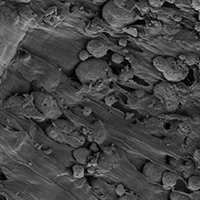
Bone bioresorbable scaffold substitutes bone physiological functionalities during its life span. In addition to biological and mechanical performances, bioresorbable scaffolds have to show structure material homogeneity, non-toxic degradation products and degradation rate proportional to new bone growth. In this study, the compositional and structural characteristics of bioresorbable polycaprolactone (PCL)/ hydroxyapatite (HA) scaffolds, produced via laser powder bed fusion in lattice forms (with diamond and rhombic dodecahedron elementary unit cells, respectively), were analyzed in terms of comparison between starting powder and manufactured scaffolds. Scaffolds showed the achievement of: i) isotropic structure, necessary to obtain good mechanical properties; ii) chemical composition enhancing cells adhesion to the scaffold surface and iii) crystallinity that preserves structure integrity in physiological environment.
Downloads
How to Cite
PAGEPress has chosen to apply the Creative Commons Attribution NonCommercial 4.0 International License (CC BY-NC 4.0) to all manuscripts to be published.
An Open Access Publication is one that meets the following two conditions:
- the author(s) and copyright holder(s) grant(s) to all users a free, irrevocable, worldwide, perpetual right of access to, and a license to copy, use, distribute, transmit and display the work publicly and to make and distribute derivative works, in any digital medium for any responsible purpose, subject to proper attribution of authorship, as well as the right to make small numbers of printed copies for their personal use.
- a complete version of the work and all supplemental materials, including a copy of the permission as stated above, in a suitable standard electronic format is deposited immediately upon initial publication in at least one online repository that is supported by an academic institution, scholarly society, government agency, or other well-established organization that seeks to enable open access, unrestricted distribution, interoperability, and long-term archiving.
Authors who publish with this journal agree to the following terms:
- Authors retain copyright and grant the journal right of first publication with the work simultaneously licensed under a Creative Commons Attribution License that allows others to share the work with an acknowledgement of the work's authorship and initial publication in this journal.
- Authors are able to enter into separate, additional contractual arrangements for the non-exclusive distribution of the journal's published version of the work (e.g., post it to an institutional repository or publish it in a book), with an acknowledgement of its initial publication in this journal.
- Authors are permitted and encouraged to post their work online (e.g., in institutional repositories or on their website) prior to and during the submission process, as it can lead to productive exchanges, as well as earlier and greater citation of published work.